CHAPTER 34
He impressed me, so I didn’t linger
As on him I put my finger
To be our top hand
Driving steers ‘cross the land
So I hired him, this boy Raney Springer
I had just returned the day before from my trip down south, and told Limerick that I had hired the man that would be our new trail boss. He would arrive in a few weeks in time for the roundup and a little training. This year he would accompany the Goodnight herd as our agent. If he proved out, next year he would be trail boss over our herd. Limerick and I had drunk a toast--or two--to our new acquisition. Apparently the cheap whiskey—Limerick’s Jack Daniel’s had run out long ago—had affected me more than I thought, for I woke up with that idiotic verse running through my head. (You would think that whatever “muse” I have could at least do better than to rhyme Springer with finger and linger!)
Our trust was not in vain. Raney was young, but already had a lot of experience. Goodnight told me he wished he had found him first. The fact is, he could’ve paid him more, but Charlie wouldn’t have done that—and Raney was the kind of fellow that once a commitment was made, he stuck with it.
And he had some good ideas, too. When he returned from that first drive with Goodnight, he suggested that we start using the new trail to the railhead at Abilene, Kansas. Sometimes us older fellows have to be convinced, but Springer was a thinker as well as a worker. He pointed out that the eastern markets were crying for beef, that the trail was much shorter, meaning the cattle would have more weight and be less stressed when they got to market. All that, of course meant more profit, since the steers would weight more, probably bring a better price, and we wouldn’t have to pay drovers for as many days on the trail. More profit was music to my ears and Limerick’s eyes practically got misty at the prospect.
Raney would help us get wintered in, then go back to Cuero to see his folks. That’s what he told us he was doing, but the fact is he was courting that Thigpen girl. It wasn’t really a secret, since I had know it from the beginning, and since I went to Cuero myself for a day or two to see Bachman on my annual Christmas trip to see Bettie.
So when he came up one spring and told us he had gotten married, it was no surprise—except that he wasn’t even old enough to vote yet. (Not that it mattered much--Texas was still in the grips of Reconstruction and the Radical Republicans!) He told us he had left Martha Ann with her folks while he was on the trail.
“How’s that young’un Will?” I asked him. “Guess he’s your new brother-in-law?”
“That ornery rascal has only two things on his mind, Boss. Being a cowboy and marrying Catherine Bachman! I’ve never seen a thirteen-year-old kid with that kind of ambition!”
“If you can call wanting to be a ‘cowboy’ an ambition,” I remarked.
“I’m afraid he holds me and my profession in high regard—too high. But what I’m really talking about is his attraction to Kate. I mean, she IS an attractive woman, but hell, she’s ten years older’n him. I might understand if it was the other way around—or even if he was twenty or so—but that just don’t seem natural for a thirteen-year-old kid! None of my business, though, I guess.”
Limerick chimed in. “Not that I have the slightest interest in this, but surely this ‘older woman’ has no interest in a BOY.”
“Well, now, that’s the damnedest thing about it, in a way,” Raney answered. “Kate is a nice looking woman, and there are fellows in Dewitt County who would be a good husband for her. But she seems not to have the least interest in any of them.”
“Is she attracted to this boy--‘Will’, was it?” Limerick asked
“Oh, she would probably say ‘He’s cute.’ but no, I don’t think in any serious sort of way. She is powerfully devoted to her Daddy, though. I really think she probably figures no man can measure up to him. To be honest, I wouldn’t be surprised if Parson Bachman sort of thinks that himself. I’m pretty sure he don’t encourage her to court.”
“That sounds like John,” I put in, “but whatever Katie does or doesn’t do ain’t getting theses cows seen after. Let’s get to it.”
….
Raney was right. The Abilene Trail—which became known as the Chisholm Trail—proved more profitable, and popular, than the Goodnight trail, though there were reasons to use the old one, and we occasionally did. As the rails took Texas beef east, it brought back settlers. More settlers meant more farms and towns, which made it harder to get cattle to market, so the railhead kept moving west.
We kept raising cattle in Texas. Goodnight had established his operation in Colorado. I never saw him, but we kept in touch with each other through what I guess you’d call cattlemen’s gossip. As in any business there were ups and downs, but Limerick was good manager, Springer was good trail boss and me, well I guess I was just lucky to be in association with those two.
But change was in the Texas wind.
CHAPTER 35
As I said, the Chisholm Trail became popular. The cattle business was profitable, which brought people into the business that never should have messed with it. More cattlemen meant more cattle, which meant falling prices. We were holding on, but just barely.
The year 1874 was a banner year for Texas. Sometimes it seems like things go on forever hardly changing at all, then everything happens in a rush. First of all, Reconstruction was over--in Texas, anyhow. Now, Texas had done better during Reconstruction than a lot of the South, probably because there was so much room to grow. A lot of the Old South had become worn out with cotton planting. Freeing the slaves, although a good thing and long overdue, meant a lot of mouths to feed, and no good way to do it. The Lone Star State, however, had lots of room, lots of potential. The cattle business was part of that, but manufacturing, farming, and other industry—including the railroads—grew after the war.
In 1874 the US Army got serious about the Indians of the Southern Plains—the Comanches, the Kiowas, and the Southern Cheyennes—who had been given reservations in the Oklahoma and Indian Territories. Just a few years earlier, General Sherman had narrowly escaped losing his hair to a Kiowa war party. Texans had been complaining that the reservation Indians were raiding into the state. After an inspection tour where all seemed quiet, Sherman found that a wagon train on the same trail he had just traversed had been attacked and most of the people killed. Colonel Ranald Mackenzie at Fort Richardson—just a days ride or so from the ranch—was sent to capture and punish the guilty parties.
In the spring of ’74, buffalo hunters in the Panhandle were attacked. Those in the trading settlement of Adobe Walls were able to fight them off, but if the Indians caught a hunter on the plains, the hunter was a goner. When the army at Ft. Dodge got word of this, they decided to put an end to the Indian depredations in Texas once and for all. Units from Ft. Richardson and Ft. Concho in Texas, as well as forts in New Mexico, Kansas, and Oklahoma converged on the plains. In September, Mackenzie caught the Comanches in Palo Duro Canyon. There were few casualties on either side, but the army destroyed the Indians’ lodges, food, clothing, and horses. The Comanches under Quanah held out for another year, but he could see the writing on the wall, and brought his followers into the reservation.
There are a few things worth mentioning here. First of all, some folks say that the hunters were on land that the government had promised the Indians in the Medicine Lodge Treaty. Now, I won’t say that the Indians didn’t have some grievances, but the fact is that the federal government never had any right to promise any land in Texas to anybody. When Texas joined the union, she retained the rights to all public land within her current boundaries. (We had to give up half of New Mexico to do it…but who needs eastern New Mexico?)
Secondly, some folks had criticized Mackenzie for killing those horses. Now, I hate to see the destruction of a good horse, but a few years earlier, Mackenzie had captured a herd of Indian horses, only to have the Indians recapture them a bit later—taking with them all of the command’s own mounts. I can only imagine how it galled all of those cavalrymen to walk hundreds of miles back to their post. Mackenzie was not going to let that happen again.
And lastly, I knew Quanah was a fierce warrior. Only after he surrendered did I learn he was the son of Cynthia Ann Parker and her Comanche husband Nocona. All those years ago, when we attacked the camp on the Pease, we knew Cynthia Ann’s son had escaped, but I had no idea he was the one causing us so much hell on the frontier. And it should be noted here also that Quanah was not only the greatest Comanche chief in war—but the greatest in peace as well, helping his people adjust to life on the reservation.
…
So by the end of 1875, the cattle market had crashed and the Plains were free of Indians. I got a letter from Charlie Goodnight.
Oh, I almost forgot to mention…while the Army was winning on the Plains, there was another victory of sorts hundreds of miles to the south. Just a day or two after Mackenzie’s victory in the Palo Duro, Mary Catherine Bachman said “I do” to William Henry Thigpen. She was twenty seven; he was seventeen.
CHAPTER 36
I was down for my regular Christmas trip and it almost seemed to be getting harder than easier. Bettie looked more and more like her mother every day. By now she was nineteen and I fully expected that every letter I got from her to mention some beau. Apparently she was waiting until I came to see her.
Gundar Stedje seemed like a nice enough fellow, even with that name. I had known Mexicans, Germans, Irishmen, Englishmen, Scots, Frenchmen, Indians, and maybe one or two Poles and Italians--even a Jew or two. But this was my first honest-to-God Norwegian. I didn’t know much about them, so I didn’t know what to expect. If Gundar is at all typical, I can say that they are honest, hard-working people, fiercely loyal, and stubborn as hell—sort of like Germans.
Bettie had met the boy at church, which I guess was a good sign. Turns out Norskis are even more Lutheran than Germans, if that’s possible. The Weinheimers vouched for the boy’s character, and Bettie was plum goofy over him, so what could I do but give my blessing? And at least (last name) is easier to say than some. The boy was strong and good-looking, with hair just a shade darker than Bettie’s so at least the grandkids would be good-looking.
When I went to see Bachman that trip, he assured me that Catherine and Will were happy.
“I can’t say I would have picked Will as a husband for my oldest daughter,” he told me, “for a number of reasons, but he’s a hard worker and mature beyond his years…and he seems to love her with a passion. More importantly, she loves him. Here…let me show you their wedding pictures.”
He passed me a couple of the new-fangled photographs on postal cards. I thought it odd that their wedding pictures were separate—he in one shot and she in another.
John explained, “The photographer said that it was the best way to do it, since they wanted the postal cards—a little cheaper. To be honest, I think he was pretty certain the marriage wouldn’t ‘take’, so this way he provided Catherine with pictures she wouldn’t have to hide or alter if it didn’t. Or it may have been because they were dressed so differently that he thought it would look odd if they were side by side.”
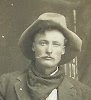
Sure enough, Will was dressed like he just got off his horse. His Stetson hat was tilted rakishly, and one booted foot was propped on a wicker chair. In an effort to look older, he had grown a wispy moustache.
“That boy’s damn sure a cowboy, ain’t he? Couldn’t even put on a suit for his wedding!”
“Don’t be so hard on him, Dusty. If you’ll notice he IS wearing a suit—AND a tie,” John said with t twinkle in his eye.
I looked again. “Why, he damn sure is, ain’t he? I almost missed it underneath that bandana!”
We laughed, then Bachman handed me the other. “Here’s Catherine.”
Katie was all in white as a bride should be. I’d bet that dress set John back a few dollars, but it was none of my business.
“She’s a beauty,” I told him. He nodded. “John, are you OK with this? And how does Caroline feel?”
“Dusty you’re about to find out that no matter how old or how mature your daughter is, she will always be your little girl. Catherine is special to me, and I loved having her around, but I didn’t want her to be an old maid. If she and Will are happy—and remain so—then so am I. As for Caroline…it’s hard to say—but then I never could figure women.”
“Amen to that, Brother! Where are the newlyweds, anyway?”
“Will has taken a job with the King Ranch. Looks promising. They have some sort of plan there where employees can accumulate their own herd, depending on how long they stay. Will’s idea is to work until he has about a hundred head, then go off on his own. I tell you, the boy plans ahead.”
“I hope it works out for him. Personally I don’t think Richard King is all he wants folks to believe he is. But—I wish them the best.”
“What about you, Miles? I understand you’ve fallen on bad times.”
“Well, yeah, but things are looking up. We took a real beating this year on our cattle—all the ranchers did. Even Ol’ Goodnight up in Colorado. He’s like your new son-in-law, though—always working some deal. He got some Irishman or Englishman or something to back him on a project in Palo Duro Canyon in the Panhandle. Offered me a job. Think I’ll sell out to Limerick and take him up on it.”
“So your partner’s capable of doing that—buying you out?”
“You bet. Say, I’ll bet I forgot to tell you. ‘Course you knew Addy died.”
“Well, certainly, he’s Caroline’s brother. Got bit by a rattlesnake early last spring. Terrible thing. How’s Monica?”
“Yeah, it had warmed up and this big rattler come out of hibernating in the wood pile, full of venom and mad as hell. Addy wasn’t even thinking about it. He was a fine fellow and Monica loved him something fierce. But after he died she came out to see me and—here’s what I forgot to tell you--that damnyankee carpetbagging Irish son of a bitch paartner of mine is going to be my damnyankee carpetbagging Irish son of a bitch BROTHER-IN-LAW! Ain’t that a hell of a note? I had a Mexican mother, Spanish and French ancestors, a Southern father, married a German fraulein, gonna have a Norwegian son-in-law and a Yankee Irish brother in law! Hell, I’m going to write Ulysses S. Grant and tell him I want to be an ambassador!”
CHAPTER 37
I stopped back in New Braunfels to see Bettie once more. I knew it would likely be a long time before I saw her again—the Panhandle is a long way from the Hill Country. I wished her the best, and told her I’d send her something when I got the ranch sold. She said that just having my blessing to marry Gundar was enough of a wedding present. She was a wonderful daughter—I think she would be disappointed to know that I always left feeling like I had failed her.
I was in no hurry to get to Pueblo, so I swung down to San Antone to look it over. I couldn’t believe the change in the old town. The downtown streets were paved with mesquite blocks, the railroad was coming, and the Alamo was a beer warehouse. I was tempted to stay one night in the Menger Hotel—just to say I had—but frugality restrained me.
I left San Antone on the road to Fort Concho. I wanted to travel the Goodnight trail one more time. Besides, while the Plains Indians had been subdued, the Apaches—and bandits--were still active in the southwest, and I figured the well-traveled routes were the safest for a fellow traveling alone. I was hardly alone, however, as there wasn’t a day pass I didn’t meet somebody or pass a ranch. Sheepmen were moving into the country, and I passed quite a few…what do they call them? Flocks? Herds? Anyway, a lot of sheep were being raised in the area. I never had much use for them myself, but they tell me that country’s ideal for them.
Fort Sumner had changed, too, as everything does. The Navajos had been allowed to return to their own part of the country and the government buildings had been purchased by Lucien Maxwell, a huge landowner that I ranked with the likes of Richard King. I decided to have a real meal while in Ft. Sumner and went to a café. Waiting tables and swamping out the place was a young fellow I wouldn’t have taken much notice of, except he made me think of my own boy, dead these many years. Johnny would have been about this kid’s age when he was killed by the Comanches.
Business was a little slow so I engaged the young man in conversation. He told me he had been born in New York, but had come west with his mother and step-father just a couple of years before. She had since passed away and her husband had abandoned the boy, so he was making his own way. He seemed destined to make a name for himself, so I asked him what it was—his name, that is.
“That depends, sir,” he answered politely. “I was born Bonney, but after my pa died, Ma married a McCarty, then Antrim. My first name is William and my middle name is Henry, and I’ve been called just about all combinations of those. Personally, I’m a little partial to ‘Billy’.”
Just then the proprietor of the joint stuck his head through the kitchen door and hollered, “Kid, I don’t pay you to chat, and these dishes ain’t washing themselves.”
Billy grinned as he headed toward the kitchen. “Or,” he said, “like everybody else, you can just call me ‘Kid’.”
CHAPTER 38
I found Goodnight on the upper Canadian, mostly waiting to see if the Comanches were sure enough going to stay on the reservation. He became convinced they were, so we started moving cattle towards the Texas Panhandle. Charlie had hired a guide—a local fellow named Nicolas Martinez—a former Comanchero who knew all the old Indian trails. When I met him I kept thinking I had seen him before, finally deciding that he just reminded me of somebody I once knew. After all, I had grown up around Mexicans, and was related to a bunch of them.
One night around the campfire we got to telling tales and I told the old family story about L’Archeveque, my French ancestor who had lured LaSalle into a trap.
Nick’s eyes lit up. “You are related to Archibeque?”
“Well, my mother was, way back there. I guess that means I am. Why?”
“Senor Doosty, there are many Archibeques in New Mexico. Most of them are fine people. But there is one…he is hombre muy mal.”
“A bad fellow, eh? Why do you say that?”
“He would as soon kill you as look at you—and that is for his paisanos…his countrymen. For gringos, he would rather kill you as look at you. And if he thinks that his Spanish blood has been mingled with gringo blood…Senor, I would just keep that bit of information to myself.”
“Doesn’t mind being part French, but not part gringo, eh? Hell, I’ve always been proud of my Spanish heritage, but that French part I could do without, if I could. I’ll take heed, though, Nick. I don’t want to cause any trouble.”
There was a period of quiet and Nick pulled something out of his vest pocket. He rubbed it against the leg of his pants to shine it and looked at it in the firelight. I asked if I could see it.
“Si, but cuidado, senor. I have had it a long time. I carry it para buena suerte.”
“A good luck charm, eh?” I said as he dropped it in my hand.
It was originally a silver coin, minted in Mexico. Pieces had been cut out of the inside to form a star within a circle. At the points of the star were the letters T-E-X-A-S. The work was crude as if done by an unpracticed hand. I had seen a few of these. In my youth I had even made one or two myself. I flipped it over.
“Dios mio!” I said, reverting to the language of my childhood. “Where did you get this?”
“Many years ago, Senor. A bunch of loco Texans had gotten lost on the Llano. (Even today you need a New Mexican guide, no?)” he said with a twinkle in his eye. “I was sent to rescue them. The young Texan who went with us gave me this silver coin in gratitude, but first, he carved his initials—J.F.M. I have kept it these many years as a token—and a good luck charm, as you call it. He was a fine young man—very polite, even if he was a Tejano Loco! Ha ha!”
“Did the Tejano Loco tell you his name was Pancho.”
“Si, senor. Pancho is short for Francisco, his middle name.”
“Do you recall the other Tejanos Locos calling him something else?”
“Si, but I do not recall what it was. It did not translate to Espanol, so he went by ‘Pancho’. (In those days I could not speak Engles well, as I do now.) It’s strange, but for some reason I think it had to do with dirt. Would they have called him ‘Dirty’?”
It was all I could do to keep from laughing and crying and screaming, all at the same time.
“No, they probably called him ‘Dusty’”
“Oh, si, senor, like you.” I wish that Austin photographer could have been there to get a picture of the way Nick’s mouth fell open and his eyes popped out.
“Era usted! Era usted!” he exclaimed over and over. “No puedo creerlo!”
“Believe it, mi amigo, it was me—Jackson Francisco Miles. J. F. M. -- Dusty.”
While we were cooling our heels at Camp Resolution I had carved out the coin using some of the blacksmith’s tools. It was a pretty rough piece of work—the kind of thing a kid does when he’s got time on his hands.
“Senor”, he said, “Senor Pancho,” as he embraced me. When he released me his face was wet with tears and I admit mine were a little misty. “I heard terrible things happened to you Tejanos after we parted—that many died. Perdóneme, senor, what could we do?”
“There’s nothing to forgive. You Comancheros saved our lives—from starvation, anyway. You can’t help what Armijo did.”
“Cierto” he said, wiping his eyes. “Governor Armijo was a cruel man. But I feel I must make amends, senor. You were my guest.”
“OK, Nick, here’s what you can do.”
“Si, senor, anything. Tell me anything, and I will do it for your pardon.”
“Quit calling me ‘senor’. Mi abuelo was ‘senor’. I’m just Dusty—or Pancho, if you wish.”
CHAPTER 39
I was in for quite a surprise in the Texas Panhandle—or a whole hatful of them. To begin with, as we made our way down the Canadian, I noted that many New Mexican PASTORES had beat Goodnight into the area with their flocks of sheep. Some of them were no doubt sons of the men who had rescued the Santa Fe Expedition over a quarter century earlier. Casimero Romero, “El Pastor Primero”, was just a few years older than me and remembered those times well. Nick had a good time telling Romero about his “lucky coin”.
I had been in the Canadian Valley before, but not this part of it. I was amazed at how worn the trail was. Not only had it been used by Indians for centuries, but even in the 19th century it had been traveled by Comancheros, Explorers, Traders, California gold seekers, military expeditions—you name it. Nick and Charlie explained how Vial, a Frenchman in the service of Spain, had come this way, seeking a path from Santa Fe to San Antonio nearly a hundred years ago. The Bents had established a trading post here in ‘43, but the Comanches proved more warlike than the Cheyenne, and Bent had to be satisfied with his post on the Arkansas. Abert came surveying for the Topographical Engineers in ’45, Marcy in ’49 and ‘52, and Whipple in ’53, who was looking for a route for the transcontinental railroad. (The War nixed that deal.) They told me that Santa Fe trader Josiah Gregg was out here about the same time I was—except HE knew where he was and where he was going. (The smartasses got a real kick out of that!)
Kit Carson had come this way in ’64 trying to teach the Comanche and Kiowa a lesson, but nearly lost his…hair. Major “Beans” Evans traveled this way in ’68 chasing Indians toward Custer, and just a year or so previous, Major Price and soldiers from Fort Union in New Mexico had ridden here in what became known as The Red River War. That war culminated in the defeat of the Plains Indians, and that defeat is why we were here. While I was off shooting at Yankees, Charlie had stayed in the Frontier Battalion of the Texas Rangers, and often tracked Indians onto the Llano Estacado. That was when he first became aware of Palo Duro Canyon, and saw its potential as a cattle ranch. And before we left the Canadian, Charlie had made an agreement with the pastores that if they would remain on the river, he would stay in the canyon.
The second surprise was the canyon itself--much larger than I had expected and beautiful. It wasn’t easy getting the cattle down into the canyon, and even harder to get the supply wagons down—they had to be disassembled and the pieces carried on mules. But once we got to the bottom—man what a sight! The Prairie Dog Town Fork of the Red River ambled through the canyon floor (though it could become a killer torrent at times), and the rock formations were striking. The canyon was covered with cottonwood and cedar. I don’t mean that little “scrub cedar” either. There were lots of big cedar trees. They have since all been harvested for fence posts.
Charlie was back in business. His partner, John Adair provided the capital, and Goodnight provided the know-how, and me—I just worked. To be honest, it was nice not to be managing—to just get up in the morning and know you were going to do your best, but also that whether the ranch succeeded or not was not hanging on your shoulders.
The open range was doomed. What a lot of people don’t understand is what doomed it. First of all, the folks back east were tired of stringy longhorn beef—they craved a fatter, more tender meat, impossible from an animal that ranged far and wide and reproduced at will. Better breeds of cattle were called for, and generally the Hereford fit the bill.
A better breed of stock called for more security in the way of fenced pastures. Fenced pastures needed a ready source of water, hence the windmill. Folks think that it was the smallholder or the farmer that closed the open range, but in the Texas Panhandle it was the big ranches—the JA (named for Goodnight’s partner), the Frying Pan, the T-Anchor…and probably the most notable of all, the XIT, which had 6,000 miles of fence. I’ll tell you more about it later.
In the beginning, the walls of the canyon proved enough of a fence, with a few riders at the open end of the canyon to keep the stock from drifting—and to keep the buffalo, which we had driven out, from drifting back in. Charlie had heard of this new kind of wire, however, and was curious. (One thing about Goodnight, he was always an innovator.) He sent me to San Antonio to see what I could find out. I think he was just trying to get an old man out of the way for a while. But to his credit, it provided a paid trip to see my daughter. And my grandson.
CHAPTER 40
Yep, Bettie and Gundar had wasted no time in starting a family. Jack Canute Stedje was born a year after the wedding, named after his grandfathers. Bettie had faithfully continued sending me postal cards with pictures of the family and I was eager to see them all in person.
On the way down, I had to stop and see how the Limericks were doing. John seemed to have a sixth sense about the markets, and the ranch was thriving. He had brought in some good breeder stock and was improving the herd. Marriage to my little sis had been good for him, and was evident by his waistline. I had brought a bottle of bourbon as a gift, which he graciously accepted, then brought out his own bottle of Jack Daniel’s.
Startled, I asked him, “Been to Tennessee?”
“Fort Worth” he said. “You can get it there, now.”
“I’ll be damned. Well, open ‘er up and we’ll drink a toast to progress!”
He told me about some more improvements he had in mind for the place. “This spring we’re fixin’ to take the biggest herd yet down the trail…”
I almost choked on my whiskey. “What did you say?”
Stunned, he repeated, “We’re fixin’ to take…”
“Ha!” I interrupted, “I can’t believe it! My little sister has been able to accomplish what me, Palo Pinto County, and all the cowboys in Texas have been unable to do!”
“Dusty, what in hell are you talking about?”
“You really don’t know, do you, you damnyankee carperbagging son of a bitch! You just said ‘fixin’ to’! Monica has made a real Texan out of you!”
Monica had come in to see what the noise was all about. Limerick looked nonplussed. “No I didn’t,” he insisted. ”What I said was we’re fixin’ to…good God, you’re right!” He downed his shot of Jack Daniel’s.
“Here, now, no need to go wasting good sipping whiskey. As a matter of fact, fill your glass again and I’ll propose a toast.” He did, though experience had taught him to watch me closely. “Here’s to John Q. Limerick, a Boston Paddy, a Yankee soldier, a carpetbagging son of a bitch, a hell of a partner and brother-in-law, and finally…A TEXAN!!!”
Monica grabbed the bottle and said, “I’ll drink to that!” She downed a slug as Limerick and I stared. It brought tears to her eyes.There were tears in John’s eyes, too—and not all of them from the whiskey.
In a bit, he resumed the conversation. “As I was saying, we’re fixin' to take the biggest herd yet down the trail this spring. Of course Raney is still trail boss, but guess who will be his ramrod?”
“Hell, I don’t know. Not you, I hope.”
“Hardly—those days are over. His brother-in-law, Will Thigpen.”
“The hell you say! I thought he had a gravy train on the King Ranch—building up a herd or something like that.”
“To hear Will tell it,” Limerick explained, “all was not as it had been presented. He noticed that other cowboys would get close to acquiring a hundred head, and disappear without a trace.”
“What? Run off?” John shook his head. “Murdered?"
“Will says there no proof, of course, but the King Ranch is a large place with lots of remote areas—and lots of loyal KINENOS, who have been on the ranch for generations. It wouldn’t be hard to dispose of a body.”
“I’ll be damned. So did will try to collect his share?”
“Said he didn’t dare. He didn’t want to wind up at the bottom of an arroyo.”
“Well, King’s loss is our—uh, your—gain. What about Catherine?”
“Oh, she’ll come up here with him. We’ve built a place for Raney and Martha Ann--we’ll build another for Will and his wife. Not much—but enough to set up housekeeping in”
“I’ll bet that’s going to be tough on John Bachman.”
“Maybe, but he’s been talking about a move himself.”
“Where to?”
“Mason County. According to Raney, the feud between the Suttons and the Taylors got so bad that the whole county pretty much had to choose sides. The principals are at peace now, but that sort of thing does a lot of damage to a community.”
“True.” I reached for the bottle. “Well, I’m a-FIXIN’ to have one more drink, and then I’m a-FIXIN’ to turn in. Reckon in the morning I’m a-FIXIN’ to head south.” Limerick grinned and hoisted his glass.
…
I would not go to Dewitt County this trip. It was a bit out of the way, and this WAS a business trip, after all. Bettie and Gundar had settled in Bosque County where he worked for a local farmer. The county was a hotbed of Norwegians, and if that sounds like a contradiction in terms, it is.
I got directions to the farm and rode up, marveling how much the country had changed since I first rode through in 1841 on my way to Santa Fe. My thoughts were deep in the past as I rode up to the house. A ghost appeared at the door and it shook me to my bones. Bettie ran to meet me and gave me a big hug.
“Why, Pa, you’re trembling like a leaf. Are you all right?”
I gave her another hug. “Baby girl,” I said, almost weeping. “You look so much like your mother. For a minute I thought you were.”
“That’s the best compliment you could give me, Pa.”
“Now where’s that young’un I’ve ridden so far to see?”
“So you didn’t come to see me, huh?” she teased. She had her mother’s looks but her pa’s sense of humor.
A tow-headed boy was peeping out of the door. Bettie called to him, “Jackie-boy, come meet your Grandpa.”
His blue eyes brightened and he ran to me. He stopped a few feet away, looked me up and down, and asked, “Are you a cowboy?”
I glanced at Bettie and she shrugged. “Do you want me to be?” I asked him. He nodded. “Then I’m a cowboy. Come give your Grandpa a hug!” And then I learned a man will do just about anything for a grandchild.
Tuesday, November 25, 2008

Saturday, November 22, 2008
Texas Forever--Chap 31, 32, 33--Day 22
CHAPTER 31
I worked with Goodnight and Loving for a couple of years. On the second trip, Oliver was attacked by Comanches and died of his wounds. He was a great man and it was a terrible loss. It’s amazing to think that a man who had trailed cattle to New Orleans, Chicago, and Denver would die of gangrene in an outpost like Fort Sumner. I guess it’s another one of those vagaries of human existence I have yet to figure out.
In no way would I have ever wished harm to Oliver, but the fact is that I was getting older and trail driving is for young men. I hated to say anything, as Loving was older than me by several years, but it was time to find a more settled job. I approached Charlie after he had sold the cattle to the fort and told him I was quitting. He offered me a job on one of the ranches he and Loving had established in New Mexico or Colorado, but I refused.
“I’m a Texan, Charlie, born and bred. I could never be happy living anywhere else. If you ever decide you want to ranch again in Texas, give me a holler.”
“I may do that,” he said. “I’ve been thinking about setting up in the Panhandle--when they finally get the Comanches to stay on a reservation.”
“Yeah, well, that’s more like if they get the Comanches on a reservation, and not very damn likely, at that. By then I’ll be too old for anything, much less punching cattle. But I’ll be watching you from a cloud somewhere.”
He roared at that. “Hell, you’ll never die,” he said, “and when you do, if you can see me at all, it’ll be through a cloud, all right—a cloud of smoke!” He wrote me a draft on his bank account in Weatherford and wished me the best. “You just remember what I said. You’re a damn good stockman and you’ll never be happy away from cattle.”
He was right, though I had never questioned it. The fact is, unlike the younger “cow-boys” who spent their earnings as soon as they got paid, I had saved mine. I had an idea to get in the cattle market myself. I wasn’t really looking for a partner, but fate provided me one.
….
It was getting late in the year when I got back to Palo Pinto. I had worked on my place a little when I wasn’t on the trail—just enough to make it livable…and sellable. It had too many painful memories for me to want to try to make another life there. I was working on getting it fixed up to sell, so I would have a grubstake somewhere else. My plans had not fully congealed yet when I rode into town to deposit Goodnight’s check.
“Good day, Mr. Miles,” the bank teller greeted me. “Good to have you back in town for a while.” I never felt comfortable being called “mister”, but this fellow was young enough to be my son, so I guess it was okay. I expect his bosses pretty much required it of him.
“Maybe for longer than a while. Anything going on here?”
“Well, that depends of if you mean here at the bank, here in Palo Pinto, or here in Texas…but mostly the answer is no. The Republicans are still in control, the Union—uh, Federal—Army is more of a nuisance than any real help against Indians, and the damnyankee carpetbaggers are taking over.”
“Your bosses let you use the word ‘damn’ in public?”
He grinned. “Only when talking about Yankees…or damnyankees.” He handed me my receipt, then added as an afterthought, “Speaking of that, there was one in town looking for you.”
“One what?”
“A damnyankee. Now, you wouldn’t be turning scalawag on us, would you Mr. Miles?”
That would be an insult coming from some, but I just grinned back and said “Not bloody likely! Who was this fellow? What did he want?”
“I don’t really know much about it. He came in here and asked if I knew you. I told him I knew who you were, but that you were out of town on business and didn’t know when you’d return. It was just a day or two ago. He’s probably still in town.”
“What did he look like?”
“I’m sorry but I really can’t say—just average, I guess. The way he talked, though was funny as hell.” Then nervously as he glanced toward the president’s office, “I mean, he had a peculiar way of speaking. To be honest, Mr. Miles, when he spoke I just wanted to slap him!”
CHAPTER 32
I walked into the saloon and found the man I was looking for, wearing a derby hat, surrounded by a group of men who were clenching and unclenching their fists as they listened to him. Any minute now he was going down.
“Here now, fellows,” I broke in, “You wouldn’t want to rough up one of Robert E. Lee’s veterans would you?”
One of the local toughs glanced at me. “What the hell do you mean, Miles? This damnyankee is obviously a carpetbagging son of a bitch.”
“’Fraid you’ve made a mistake, young fellow. I met this man in the army. By the way, where was it you served your country?” I asked the young smart aleck.
He and the others backed down. Confederate veterans were not rare in Palo Pinto County, but I did have the added celebrity of being a prisoner of war, a son of a Texas Army veteran, and a survivor of the Santa Fe expedition—not to mention being a former Ranger and “rescuer” of Cynthia Ann Parker.
“Now why don’t you fine young men go find something productive to do.” They sulked off. When the last one had left, I turned to their intended victim.
“Limerick, you damnyankee carpetbagging son of a bitch! What in the hell are you doing in Texas? I guess you know that I just saved your sorry Irish ass!”
“Nonsense, Miles” (God, there was that Boston accent again—I wanted to slap him myself!) “I could have taken them. Besides,” he added, “I thought it was the US Cavalry that always arrived in the nick of time—not the Confederate Army!”
“Limerick, I can’t say that I’m sorry to see you, but talk like that in Reconstruction Texas will get you killed! And there’s not one damn thing the Confederate Army, the US Cavalry, or the Texas Rangers could do about it.
“And let me tell you this right now. I know what kind of fellow you are. I owe my life to you—maybe we’re even now. You’re as common a man as I have ever seen. But there’s something about that Boston accent that sets a Texan’s teeth on edge. It comes across as arrogant—like you think you’re better than everybody else. I know you can’t help it, but for God’s sake don’t advertise it! Come on, I’ll buy you a drink.”
“You’re on, Dusty.” and then more subdued, “And don’t think I don’t appreciate what you just did. I realized I was in trouble and was mighty glad to see you. I was surprised you lied to save me, though.”
“Like hell I did. Just think about what I said. You served under Robert E. Lee, right? I never said General Lee, as Colonel was as high a rank as he ever held in the US Army. I also said I knew you in the army, didn’t I? Those boys knew I served the Confederacy Army. If they wanted to assume that you did too, that was their mistake. Of course, I may tell a lie now and then, but not to save your sorry ass. Now, what’ll you have?”
Limerick turned to the bartender “A shot of Irish whiskey, my good man.”
“Damn it, Limerick, are all you Yanks so hard headed?” I turned to the bartender. “Give us a bottle of good Kentucky bourbon! I’ll show this carpertbagger what cultured people drink!!”
We found a table and opened the bottle. Limerick admitted that the bourbon was pretty good, but the next time was on him and we would open the special stock he had purchased in Tennessee on his way to Texas.
“There’s a young man in Lynchburg that makes a damned fine whiskey. I bought it special and saved it for when I could drink it with you—or over your grave.”
“Yeah, I can see you drinking it at my grave—then returning to make sure I got some of it too—after it had passed through!”
“Not a bad idea,” he commented dryly. “So, Dusty, what in hell have you been up to?”
We caught each other up the best we could. There may have been a time when the two of us could have finished the bottle at one sitting, but that time had passed a long time ago. He told me that after the War he had bounced around New England, doing first one thing and then another. He had determined that the future of the country was in the West, and Texas was a good place to start, since he had connections—meaning me, mostly.
“Damned poor connections,” I told him, “and all the camels have been turned loose.”
He laughed, poured himself another, and sipped while I told him where I had been since our parting.
“By the way”, I told him, “you Yanks like to harp about Andersonville, but I don’t know that your prisons were any better!”
“Probably not,” he allowed, “but since we won, we got to write the history. But what about your daughter?” he asked tentatively.
I told him how I had left Bettie with her uncle and aunt, but tried to see her once a year. How I was trying to be something she could be proud of, and how I was hoping to make some money I could leave her. I told him I had just left Goodnight—which prompted him to remind me of that damn limerick I had made up in the hospital. I said I was thinking about starting a small herd again on my own.
“I don’t suppose you’d consider a partner—someone who knows how to keep books?”
“As a matter of fact, not being worth a damn at keeping them myself, I was wondering how I could possible succeed. Do you know anybody who’s any good at it?”
“I just happen to know of a damnyankee carpetbagging son of a bitch who once served Robert E. Lee as a quartermaster. Will that do?”
“As long as he’s not a damyankee carpetbagging IRISH son of a bitch, we can probably work it out.”
“Sorry, then. I guess you’ll have to look elsewhere.”
“Well, hell” I said, “I had hoped to do a little better than that, but I guess it’ll have to do.”
When we went to his hotel room to get his things, he came out with a carpetbag.
“My God, man, do you have death wish? Traveling around Texas toting that thing?”
“They’re all the rage for traveling,” he said, “and so help me I had no idea!”
If he survived a year, I would be surprised.
CHAPTER 33
So I was in business with John Quincy Francis Limerick. I knew cattle and he knew bookkeeping. He was a damn shrewd trader, too, so we got the highest price for our cattle and paid the lowest price for our supplies.
The first year we didn’t have much stock, so we contracted with Goodnight to drive them for us. Limerick insisted that he would go on the drive. His stated purpose was to look out for our interests, but I knew he really wanted to see what a trail drive was like.
He found out. They had hell at Horsehead Crossing on the Pecos. That was always the case, but that year it was worse. There was also a brush with Comanches and one with Apaches. When he finally got back, he vowed that he had had his fill of trail driving.
“And I’ve got to thank you, Dusty, for teaching me to ride. We weren’t far along the trail when a couple of young bucks, assuming that my Boston accent and derby hat spelled ‘greenhorn’, decided to test my mettle by providing me with a not-quite-broken horse. Thanks to your training, I was able to ride him to a standstill. I think I had their respect after that.”
He also told me about the army chasing the Indians. “Sheridan has determined that the way to subdue the southern tribes is to attack them in winter quarters. Custer attacked a camp of peaceful Cheyennes under Black Kettle on the Washita in Oklahoma. “Beans” Evans raided a Comanche camp and only lost one man! Custer, that arrogant bastard, was not so fortunate!”
“I thought he was your famed ‘boy general’ hero of the Union Army! Funny thing is, he was stationed around Austin right after the War. He determined to keep his men civil and disallowed any foraging or looting. Bachman indicated they kind of liked the guy—for a damnyankee. Ain’t that a hell of a note John? Here you are criticizing one of the North’s heroes, while I’m defending him!”
“Well Dusty, I can’t say as how I know the man personally, but they say he abandoned some of his men to the Cheyennes on the Washita. And during the War a lot of good men were killed following the likes of him.”
“Limerick, there’s one thing we agree on. War is hell.”
…
Sometime around Christmas I made my way down to New Braunfels to see Bettie, and to visit with Henry and Hilda Weinheimer. I hate to admit it, but these visits hurt me something fierce. Bettie was looking more like her mother every trip. It hurt me to see her, and it hurt me to leave her. But I was glad I could stay in touch. Henry and Hilda were good to her, and provided her things I couldn’t. Each year she presented me with a tintype of herself. This year I could afford to give her one of me, made special for the occasion by a photographer in Austin.
While I was in the general area, I liked to drift down to Cuero and visit Bachman. I was always warmly greeted, and I could take his preaching for a while—if he didn’t lean on me too hard. When I called, there was another man there—a preacher, by the way he dressed. I hated to interrupt, but apparently their visit was over. As he walked down the steps, John called after him “I will continue to pray for you, Brother Hardin.” The man waved in thanks and walked away.
“Hardin, Hardin…where have I heard that name recently?”
“That man” Bachman told me, “is Brother James Hardin, a fellow Methodist minister.”
“Well, I haven’t been keeping track of preachers lately.”
With a sigh Bachman added. “You have probably heard of his son, whom he in high hopes named after the founder of the Methodist Church.”
“The founder of…who was…oh yeah, John Wesley. That’s where I’ve heard the name. John Wesley Hardin. Killed some soldiers, I recall. Ain’t he just a kid?”
“Wes is fifteen. And he’s breaking his father’s heart. That’s why he was here—to ask me to pray for him.” Then Bachman cheered up a bit and asked me how things were. He probably meant it from a religious angle, but I told him about quitting Goodnight and partnering with Limerick. I figured he knew more about Bettie than I did, but I showed him the picture.
“A fine likeness,” he said, just before there was knock on the door. A boy about ten or so stood on the porch.
“Howdy, Reverend Bachman” he said, removing his hat, and craning to see around John. “How are you today?”
“I’m fine, Will, and Catherine is busy. But I’d like you to meet an old friend of mine from the early days. Will Thigpen, meet Dusty Miles. Dusty, Will.”
I put out my hand to shake. The little guy was obviously on a mission, and I was an unexpected—and unwanted—part of it. The name seemed to sink in as he shook, however and, forgetting himself, asked, “What the hell kinda name is Dusty Miles?” Recovering, he glanced at the parson and said “Pleased to meet you Mr. Miles. What an interesting name.”
Something about the kid was amusingly honest. “Well,” I told him, “the Dusty part is just a nickname—and fairly appropriate, since I raise cattle and have traveled many ‘dusty miles’. But what kind of name is…what was it again?”
“THigpen,” he said, with emphasis on the “th”. “It’s an old English name, so Pa tells me.” His eyes widened. “Did you say you’re a cowboy?”
I winced. It looked like that term was going to stick. “Actually I’m a rancher. I have trailed cattle for Charles Goodnight, so I guess you could call me a ‘cowboy’…though I prefer the term ‘drover’.”
“My sister’s boyfriend is a cowboy—though he says ‘stock-driver’. A good one, too. They’re going to get married! I’m going to be a cowboy some day!” He looked around one more time as if seeking someone, frowned, then said, “Nice to meet you, Mr. Miles. And good to see you, Reverend Bachman. Tell Catherine I came by.” Before either of us could respond, he was gone.
As John shut the door, our eyes met and we both laughed. “What was that all about?” I asked.
“The Thigpens” John explained, “moved to Texas shortly before the war. They’re fine people, but a little coarse.”
“Sort of like the Miles bunch,” I countered. John blushed. “But what’s this about Catherine?”
“Young Will has become enamored of my oldest daughter. She thinks it’s cute and, against my wishes, encourages him. He says he’s going to marry her someday!” His brow furrowed.
“Good God, man…uh, I mean good grief, man, you can’t be taking the boy seriously! She must have ten years on him. And she’s growing into a good-looking woman, if you don’t mind me saying so. Somebody will steal her out from under you long before that kid gets a chance.”
“You may be right, Dusty. In some ways I hope you are, but Catherine is a joy to have around. I hope no one ‘steals’ her anytime soon.” He changed the subject. “Say, Dusty, do you need a good hand?”
“Well, I damn sure…I mean darn sure don’t need no ten-year old kid—just to get him away from your daughter.”
John laughed. “First of all Dusty, I appreciate you trying to keep from swearing in front of me, but we’ve know each other a long time. If the Lord can’t convict you of it, there’s no way I can. (And don’t tell my wife, but I occasionally lapse, myself.) And secondly, no, I wasn’t trying to get you to take Will. I was thinking about the young man he mentioned. I hear Raney Springer is—to use your terms—a damn fine drover. He has had enough experience to be a good trail boss, especially under your tutelage.”
“As a matter of fact, Limerick and I were talking about the need for an experienced hand. I’ll check this Springer fellow out.”
I worked with Goodnight and Loving for a couple of years. On the second trip, Oliver was attacked by Comanches and died of his wounds. He was a great man and it was a terrible loss. It’s amazing to think that a man who had trailed cattle to New Orleans, Chicago, and Denver would die of gangrene in an outpost like Fort Sumner. I guess it’s another one of those vagaries of human existence I have yet to figure out.
In no way would I have ever wished harm to Oliver, but the fact is that I was getting older and trail driving is for young men. I hated to say anything, as Loving was older than me by several years, but it was time to find a more settled job. I approached Charlie after he had sold the cattle to the fort and told him I was quitting. He offered me a job on one of the ranches he and Loving had established in New Mexico or Colorado, but I refused.
“I’m a Texan, Charlie, born and bred. I could never be happy living anywhere else. If you ever decide you want to ranch again in Texas, give me a holler.”
“I may do that,” he said. “I’ve been thinking about setting up in the Panhandle--when they finally get the Comanches to stay on a reservation.”
“Yeah, well, that’s more like if they get the Comanches on a reservation, and not very damn likely, at that. By then I’ll be too old for anything, much less punching cattle. But I’ll be watching you from a cloud somewhere.”
He roared at that. “Hell, you’ll never die,” he said, “and when you do, if you can see me at all, it’ll be through a cloud, all right—a cloud of smoke!” He wrote me a draft on his bank account in Weatherford and wished me the best. “You just remember what I said. You’re a damn good stockman and you’ll never be happy away from cattle.”
He was right, though I had never questioned it. The fact is, unlike the younger “cow-boys” who spent their earnings as soon as they got paid, I had saved mine. I had an idea to get in the cattle market myself. I wasn’t really looking for a partner, but fate provided me one.
….
It was getting late in the year when I got back to Palo Pinto. I had worked on my place a little when I wasn’t on the trail—just enough to make it livable…and sellable. It had too many painful memories for me to want to try to make another life there. I was working on getting it fixed up to sell, so I would have a grubstake somewhere else. My plans had not fully congealed yet when I rode into town to deposit Goodnight’s check.
“Good day, Mr. Miles,” the bank teller greeted me. “Good to have you back in town for a while.” I never felt comfortable being called “mister”, but this fellow was young enough to be my son, so I guess it was okay. I expect his bosses pretty much required it of him.
“Maybe for longer than a while. Anything going on here?”
“Well, that depends of if you mean here at the bank, here in Palo Pinto, or here in Texas…but mostly the answer is no. The Republicans are still in control, the Union—uh, Federal—Army is more of a nuisance than any real help against Indians, and the damnyankee carpetbaggers are taking over.”
“Your bosses let you use the word ‘damn’ in public?”
He grinned. “Only when talking about Yankees…or damnyankees.” He handed me my receipt, then added as an afterthought, “Speaking of that, there was one in town looking for you.”
“One what?”
“A damnyankee. Now, you wouldn’t be turning scalawag on us, would you Mr. Miles?”
That would be an insult coming from some, but I just grinned back and said “Not bloody likely! Who was this fellow? What did he want?”
“I don’t really know much about it. He came in here and asked if I knew you. I told him I knew who you were, but that you were out of town on business and didn’t know when you’d return. It was just a day or two ago. He’s probably still in town.”
“What did he look like?”
“I’m sorry but I really can’t say—just average, I guess. The way he talked, though was funny as hell.” Then nervously as he glanced toward the president’s office, “I mean, he had a peculiar way of speaking. To be honest, Mr. Miles, when he spoke I just wanted to slap him!”
CHAPTER 32
I walked into the saloon and found the man I was looking for, wearing a derby hat, surrounded by a group of men who were clenching and unclenching their fists as they listened to him. Any minute now he was going down.
“Here now, fellows,” I broke in, “You wouldn’t want to rough up one of Robert E. Lee’s veterans would you?”
One of the local toughs glanced at me. “What the hell do you mean, Miles? This damnyankee is obviously a carpetbagging son of a bitch.”
“’Fraid you’ve made a mistake, young fellow. I met this man in the army. By the way, where was it you served your country?” I asked the young smart aleck.
He and the others backed down. Confederate veterans were not rare in Palo Pinto County, but I did have the added celebrity of being a prisoner of war, a son of a Texas Army veteran, and a survivor of the Santa Fe expedition—not to mention being a former Ranger and “rescuer” of Cynthia Ann Parker.
“Now why don’t you fine young men go find something productive to do.” They sulked off. When the last one had left, I turned to their intended victim.
“Limerick, you damnyankee carpetbagging son of a bitch! What in the hell are you doing in Texas? I guess you know that I just saved your sorry Irish ass!”
“Nonsense, Miles” (God, there was that Boston accent again—I wanted to slap him myself!) “I could have taken them. Besides,” he added, “I thought it was the US Cavalry that always arrived in the nick of time—not the Confederate Army!”
“Limerick, I can’t say that I’m sorry to see you, but talk like that in Reconstruction Texas will get you killed! And there’s not one damn thing the Confederate Army, the US Cavalry, or the Texas Rangers could do about it.
“And let me tell you this right now. I know what kind of fellow you are. I owe my life to you—maybe we’re even now. You’re as common a man as I have ever seen. But there’s something about that Boston accent that sets a Texan’s teeth on edge. It comes across as arrogant—like you think you’re better than everybody else. I know you can’t help it, but for God’s sake don’t advertise it! Come on, I’ll buy you a drink.”
“You’re on, Dusty.” and then more subdued, “And don’t think I don’t appreciate what you just did. I realized I was in trouble and was mighty glad to see you. I was surprised you lied to save me, though.”
“Like hell I did. Just think about what I said. You served under Robert E. Lee, right? I never said General Lee, as Colonel was as high a rank as he ever held in the US Army. I also said I knew you in the army, didn’t I? Those boys knew I served the Confederacy Army. If they wanted to assume that you did too, that was their mistake. Of course, I may tell a lie now and then, but not to save your sorry ass. Now, what’ll you have?”
Limerick turned to the bartender “A shot of Irish whiskey, my good man.”
“Damn it, Limerick, are all you Yanks so hard headed?” I turned to the bartender. “Give us a bottle of good Kentucky bourbon! I’ll show this carpertbagger what cultured people drink!!”
We found a table and opened the bottle. Limerick admitted that the bourbon was pretty good, but the next time was on him and we would open the special stock he had purchased in Tennessee on his way to Texas.
“There’s a young man in Lynchburg that makes a damned fine whiskey. I bought it special and saved it for when I could drink it with you—or over your grave.”
“Yeah, I can see you drinking it at my grave—then returning to make sure I got some of it too—after it had passed through!”
“Not a bad idea,” he commented dryly. “So, Dusty, what in hell have you been up to?”
We caught each other up the best we could. There may have been a time when the two of us could have finished the bottle at one sitting, but that time had passed a long time ago. He told me that after the War he had bounced around New England, doing first one thing and then another. He had determined that the future of the country was in the West, and Texas was a good place to start, since he had connections—meaning me, mostly.
“Damned poor connections,” I told him, “and all the camels have been turned loose.”
He laughed, poured himself another, and sipped while I told him where I had been since our parting.
“By the way”, I told him, “you Yanks like to harp about Andersonville, but I don’t know that your prisons were any better!”
“Probably not,” he allowed, “but since we won, we got to write the history. But what about your daughter?” he asked tentatively.
I told him how I had left Bettie with her uncle and aunt, but tried to see her once a year. How I was trying to be something she could be proud of, and how I was hoping to make some money I could leave her. I told him I had just left Goodnight—which prompted him to remind me of that damn limerick I had made up in the hospital. I said I was thinking about starting a small herd again on my own.
“I don’t suppose you’d consider a partner—someone who knows how to keep books?”
“As a matter of fact, not being worth a damn at keeping them myself, I was wondering how I could possible succeed. Do you know anybody who’s any good at it?”
“I just happen to know of a damnyankee carpetbagging son of a bitch who once served Robert E. Lee as a quartermaster. Will that do?”
“As long as he’s not a damyankee carpetbagging IRISH son of a bitch, we can probably work it out.”
“Sorry, then. I guess you’ll have to look elsewhere.”
“Well, hell” I said, “I had hoped to do a little better than that, but I guess it’ll have to do.”
When we went to his hotel room to get his things, he came out with a carpetbag.
“My God, man, do you have death wish? Traveling around Texas toting that thing?”
“They’re all the rage for traveling,” he said, “and so help me I had no idea!”
If he survived a year, I would be surprised.
CHAPTER 33
So I was in business with John Quincy Francis Limerick. I knew cattle and he knew bookkeeping. He was a damn shrewd trader, too, so we got the highest price for our cattle and paid the lowest price for our supplies.
The first year we didn’t have much stock, so we contracted with Goodnight to drive them for us. Limerick insisted that he would go on the drive. His stated purpose was to look out for our interests, but I knew he really wanted to see what a trail drive was like.
He found out. They had hell at Horsehead Crossing on the Pecos. That was always the case, but that year it was worse. There was also a brush with Comanches and one with Apaches. When he finally got back, he vowed that he had had his fill of trail driving.
“And I’ve got to thank you, Dusty, for teaching me to ride. We weren’t far along the trail when a couple of young bucks, assuming that my Boston accent and derby hat spelled ‘greenhorn’, decided to test my mettle by providing me with a not-quite-broken horse. Thanks to your training, I was able to ride him to a standstill. I think I had their respect after that.”
He also told me about the army chasing the Indians. “Sheridan has determined that the way to subdue the southern tribes is to attack them in winter quarters. Custer attacked a camp of peaceful Cheyennes under Black Kettle on the Washita in Oklahoma. “Beans” Evans raided a Comanche camp and only lost one man! Custer, that arrogant bastard, was not so fortunate!”
“I thought he was your famed ‘boy general’ hero of the Union Army! Funny thing is, he was stationed around Austin right after the War. He determined to keep his men civil and disallowed any foraging or looting. Bachman indicated they kind of liked the guy—for a damnyankee. Ain’t that a hell of a note John? Here you are criticizing one of the North’s heroes, while I’m defending him!”
“Well Dusty, I can’t say as how I know the man personally, but they say he abandoned some of his men to the Cheyennes on the Washita. And during the War a lot of good men were killed following the likes of him.”
“Limerick, there’s one thing we agree on. War is hell.”
…
Sometime around Christmas I made my way down to New Braunfels to see Bettie, and to visit with Henry and Hilda Weinheimer. I hate to admit it, but these visits hurt me something fierce. Bettie was looking more like her mother every trip. It hurt me to see her, and it hurt me to leave her. But I was glad I could stay in touch. Henry and Hilda were good to her, and provided her things I couldn’t. Each year she presented me with a tintype of herself. This year I could afford to give her one of me, made special for the occasion by a photographer in Austin.
While I was in the general area, I liked to drift down to Cuero and visit Bachman. I was always warmly greeted, and I could take his preaching for a while—if he didn’t lean on me too hard. When I called, there was another man there—a preacher, by the way he dressed. I hated to interrupt, but apparently their visit was over. As he walked down the steps, John called after him “I will continue to pray for you, Brother Hardin.” The man waved in thanks and walked away.
“Hardin, Hardin…where have I heard that name recently?”
“That man” Bachman told me, “is Brother James Hardin, a fellow Methodist minister.”
“Well, I haven’t been keeping track of preachers lately.”
With a sigh Bachman added. “You have probably heard of his son, whom he in high hopes named after the founder of the Methodist Church.”
“The founder of…who was…oh yeah, John Wesley. That’s where I’ve heard the name. John Wesley Hardin. Killed some soldiers, I recall. Ain’t he just a kid?”
“Wes is fifteen. And he’s breaking his father’s heart. That’s why he was here—to ask me to pray for him.” Then Bachman cheered up a bit and asked me how things were. He probably meant it from a religious angle, but I told him about quitting Goodnight and partnering with Limerick. I figured he knew more about Bettie than I did, but I showed him the picture.
“A fine likeness,” he said, just before there was knock on the door. A boy about ten or so stood on the porch.
“Howdy, Reverend Bachman” he said, removing his hat, and craning to see around John. “How are you today?”
“I’m fine, Will, and Catherine is busy. But I’d like you to meet an old friend of mine from the early days. Will Thigpen, meet Dusty Miles. Dusty, Will.”
I put out my hand to shake. The little guy was obviously on a mission, and I was an unexpected—and unwanted—part of it. The name seemed to sink in as he shook, however and, forgetting himself, asked, “What the hell kinda name is Dusty Miles?” Recovering, he glanced at the parson and said “Pleased to meet you Mr. Miles. What an interesting name.”
Something about the kid was amusingly honest. “Well,” I told him, “the Dusty part is just a nickname—and fairly appropriate, since I raise cattle and have traveled many ‘dusty miles’. But what kind of name is…what was it again?”
“THigpen,” he said, with emphasis on the “th”. “It’s an old English name, so Pa tells me.” His eyes widened. “Did you say you’re a cowboy?”
I winced. It looked like that term was going to stick. “Actually I’m a rancher. I have trailed cattle for Charles Goodnight, so I guess you could call me a ‘cowboy’…though I prefer the term ‘drover’.”
“My sister’s boyfriend is a cowboy—though he says ‘stock-driver’. A good one, too. They’re going to get married! I’m going to be a cowboy some day!” He looked around one more time as if seeking someone, frowned, then said, “Nice to meet you, Mr. Miles. And good to see you, Reverend Bachman. Tell Catherine I came by.” Before either of us could respond, he was gone.
As John shut the door, our eyes met and we both laughed. “What was that all about?” I asked.
“The Thigpens” John explained, “moved to Texas shortly before the war. They’re fine people, but a little coarse.”
“Sort of like the Miles bunch,” I countered. John blushed. “But what’s this about Catherine?”
“Young Will has become enamored of my oldest daughter. She thinks it’s cute and, against my wishes, encourages him. He says he’s going to marry her someday!” His brow furrowed.
“Good God, man…uh, I mean good grief, man, you can’t be taking the boy seriously! She must have ten years on him. And she’s growing into a good-looking woman, if you don’t mind me saying so. Somebody will steal her out from under you long before that kid gets a chance.”
“You may be right, Dusty. In some ways I hope you are, but Catherine is a joy to have around. I hope no one ‘steals’ her anytime soon.” He changed the subject. “Say, Dusty, do you need a good hand?”
“Well, I damn sure…I mean darn sure don’t need no ten-year old kid—just to get him away from your daughter.”
John laughed. “First of all Dusty, I appreciate you trying to keep from swearing in front of me, but we’ve know each other a long time. If the Lord can’t convict you of it, there’s no way I can. (And don’t tell my wife, but I occasionally lapse, myself.) And secondly, no, I wasn’t trying to get you to take Will. I was thinking about the young man he mentioned. I hear Raney Springer is—to use your terms—a damn fine drover. He has had enough experience to be a good trail boss, especially under your tutelage.”
“As a matter of fact, Limerick and I were talking about the need for an experienced hand. I’ll check this Springer fellow out.”
Friday, November 21, 2008
Texas Forever -- Day 21 -- Chaps 28, 29, 30
CHAPTER 28
The nine-year old girl in front of me was mostly knees and elbows, and showed signs of eventually being a tall woman. Also of being a beautiful woman, for she had her mother’s full-moon colored hair. I thought that Bettie would be shy, not having seen me since she was five, but she apparently had her mother’s boldness as well. I was also afraid she would have nothing to do with me, thinking I had abandoned her, but I was wrong there, too.
After recuperating to the point where I was ambulatory, I had spent the rest of the year in a Northern prison camp. It was no church picnic, I can tell you that, but beat the hell out of Perote. When the War was finally over, I made my way back to Texas the best way I could. Before I left the hospital I had wished Limerick the best and told him if he ever needed a job and could find his way to Texas, I’d see what I could do. He just snorted in that irritating Boston-damnyankee way and said “I’ll remember that. Palo Pinto, right?” I knew I’d never hear from him again. And for a damnyankee—he wasn’t a bad fellow.
From the hospital I was transferred to the Old Capitol Prison in Washington DC. After Appamattox—well, really after the Battle of Palomito Ranch when Texas finally surrendered, I was released and made my way back home. Thanks to some old friends of Papa’s I was able to borrow enough to book steamboat passage all the way to Jefferson. Henry Weinheimer and his wife Hilda had taken her in to their home in New Braunfels. They had loved her as if she was their own, but always careful to remind her that someday her father was coming home.
She was the only one left of my little family. And she looked so much like her mother I wanted to cry every time I looked at her. Part of me desperately wanted to take her with me, back to the ranch in Palo Pinto County, but part of me knew that I could not provide her with a decent home. I didn’t even know what kind of home I could provide for myself. The land was still there, but what would be left of the house, the corrals? The stock had all been taken by the Comanches, and I had no money to start again. Mama had died while I was being held prisoner. Addison had lost a leg and he and Monica had sold the homestead and moved to DeWitt County.
I took Bettie for a ride and told her how much I loved her. I also told her that I had no plan for making a living and didn’t know where I would end up. With a heavy heart I told her that I felt it was best to leave her with Henry and Hilda for now—until times were better. And then I waited for her reaction.
She breathed a big sigh of relief. “Oh, Pa!” she said. “You don’t know how much I was hoping for that! I love you, but Uncle Henry and Auntie Hilda have been so kind—and really need me around.” She hugged me tight and I could tell she was crying—we both were.
I stayed a few more days with Henry and Hilda and Bettie, but it was pretty awkward and I needed to be making a living. Henry had done well for himself during the War, making saddles, harness, and other leather goods for the Confederate Army. Always the shrewd Dutchman, he had insisted on being paid in gold rather than Confederate scrip, so he was not suffering as bad as most Texans.
I had been thinking about making my way up to Palo Pinto—maybe hooking up with Goodnight and seeing if I could hire on as a drover until I could make a grubstake. I was planning on walking. Can’t say as how I relished the idea, but I knew I could do it. Henry, however, in an uncommon show of generosity, fitted me out with a saddle, bridle, and a fine horse. When I told him I would pay him back as soon as possible, he insisted that I take it as a gift.
“I can’t do that,” I told him.
“I don’t know why everyone thinks only Germans are stubborn,” he responded. “I’m giving it to you as thanks for your service in the Army.”
“Oh, hell, Henry,” I shot back. “ Can see through that. You didn’t even believe in the Confederate cause.”
“Neither did you,” as I recall. He had a point. “Besides, you served proudly and you deserve more than what you got.”
“But…”
He held up his hand. “I’m not finished. You did your duty as a Texan. You suffered a wound that could have killed you. And…” he paused and spoke softly, “you lost your family in the process. Please, take the horse and rig. If not for yourself, then take it for…my sister.”
My own pain had been so deep in losing my wife and son, it had not occurred to me that Henry had also lost a very close relative.
“But…I deserted her.”
“Nonsense, you hard-headed, dumbass, Texan son-of-a-seahorse!” Henry had worked hard on cleaning up his sailor language, but in moments of high excitement, he suffered lapses. “You fought for your country—or at least what you thought your country was. That’s what soldiers do. And she could have moved her if she had wanted. We begged her to do that when we heard how the Comanche raids had increased. She refused. She wanted to keep the ranch going—for you. Mein Gott, Dusty. do you think she would want me to do less?”
I hadn’t realized that Henry had offered sanctuary to Klara and John. And I began to see that if I accepted his gift, it would in some way—at least in his eyes—be making all her hard work and sacrifice mean something.
“Henry,” I said as I took the reins, “You’re a fine man. I couldn’t wish for a better brother-in-law…or a better caretaker for my daughter.”
“So…are you headed north?”
“Not right away. I thought I might drop down to Cuero to see Bachman. How’s he doing/”
“Well, fine, Dusty. You know he’s ‘got religion’ now?”
“That may not be so bad, Henry. Hell, I did some thinking on it myself when I realized how close I came to dying. Had a lot of honest questions. Don’t know that I got any satisfactory answers, though. Maybe Bachman can answer them for me.”
“Maybe so, Dusty. It’s just that he’s a Methodist, now. A preacher—and so, well passionate!”
CHAPTER 29
As soon as I tracked Bachman down, I could see Henry was right about one thing—John was definitely passionate. He and Caroline now had eight young'uns—the youngest a babe in arms. I didn’t stay with them long. John was busy teaching school, and obviously Caroline didn’t have time to talk, with all those kids running around. When John and I did get a chance to visit, all he wanted to talk about was religion. He had come to peace with God about Klara’s death, but I just couldn’t.
Texas, like the rest of the South, was in a bad way. Nobody had any money and we were treated like a conquered territory, with blue-coated soldiers everywhere. I thought about getting back into the Rangers, but there were a couple of problems with that. One is that I was getting to old to spend my life that way—riding miles and miles in a day, sleeping on the ground at night, often at a cold and dry camp. Or so I thought.
The other was that the Rangers didn’t exist anymore. The new Republican governor, installed as part of Reconstruction, had done away with them and appointed a state police force.
“Mark my words, Miles,” John told me one night in a break from his usual religious talk. “There will be trouble over this. Most of these men on the State Police are thieves and thugs just waiting for an opportunity. Even here in Dewitt County there have been rumblings of a feud that will likely lead to bloodshed.”
“You watch yourself then,” I told him, “but it shouldn’t affect me none. I’m headed north. Got an old buddy up in Palo Pinto County might have a place for me.”
….
A few days later I was riding up top Goodnight’s place. I had finally gotten used to riding again. Four years without mounting a horse makes a fellow forget that his legs don’t naturally grow that way.
I wasn’t sure if Charlie would be glad to see me or not. He had stayed in the Rangers while I was off chasing Yankees. As a matter of fact, it was his company that had ridden up and scared off the Comanches before they could burn my place. He was the one that had found Bettie in the hidey-hole.
I needn’t have worried.
“Dusty Miles, you ol’ horse-faced, hog-wallerin’ son of a bitch!” he hollered when he recognized me. It appeared that Charles Goodnight, unlike Bachman, had remained untouched by religion. Charlie was one of the profanest men I ever knew—except for maybe Henry when he first arrived in Texas. And it was always funny, because Oliver Loving was one of the gentlest, most soft-spoken men I ever knew. But they knew each other, and they knew cattle, and they would have built a great cattle empire, I’m sure, if Loving had not gotten killed by Indians. As it was, Charlie did pretty well—but at this time that was a long way in the future.
“What are your plans, Dusty?” Charlie asked me after the, uh, pleasantries were over. “You going back to raising stock? Your place’ll need to be rebuilt first.”
I told him I really didn’t have any plans. I tried to thank him fro saving my daughter’s life, but he wouldn’t hear of it.
“Hell, just doing my job—you know that. Say, I could use a good cowhand around here. I mean a good cowhand. I can get all the cowboys I need—which is fine once they get trail broke—but it takes somebody that knows stock to get these rangy longhorns lined out to trail.”
“Trail? Where are you trailing them to? There’s no soldiers in Belknap any more. And beef is so common in Texas that you couldn’t make your money back in Austin or San Antonio.”
“Tell him, Ollie,” Goodnight remarked to Loving, who had been mostly silent.
“You are quite perceptive, Dusty,” Oliver began. “There is no market for beef in Texas. But Uncle Sam is trying his best to keep the Indians penned up on reservations. Tells them he’ll feed them beef if they stay put and learn to farm.”
“Ha! I can’t see a Comanche with a hoe in his hand—unless he was trying to kill somebody with it.”
“I agree,” Loving went on, “but over in New Mexico, the army is watching over the Navajos they rounded up and put near Ft. Sumner.”
“New Mexico? You aren’t talking about trailing a bunch of rangy longhorns across the Llano, are you?”
“Now, damn it, Dusty, let Oliver finish. And don’t go running down the Llano. There’s some fine cattle country there, if we could ever get the Comanches and Kiowas off of it.”
“Number one, don’t count on the Comanches just waltzing on to a reservation saying ‘I’m through ravaging and pillaging now. Where do I get my seed and rake?’. Number two, that land is as flat as a pancake. You couldn’t hire enough cowboys to watch over them. And number three, there’s damn little water there.”
“Blast your stubborn hide, Miles, nobody ever said you could make a farmer out of a Comanche. (Well, maybe some of them Quakers back east, but nobody that’s had any dealings with them.) But as for making a ranch, there’s a big canyon up there that would keep the cattle in fine—it would just take a few men to watch one end of it. There’s a stream running through the canyon—and besides, there’s more water on the Llano than you might believe.”
“Well there was damn little when I crossed it in ’41. But anyway, Oliver, you were saying…?"
“Right, Dusty. I was saying that we would trail the cattle to the army posts in New Mexico and maybe points further north. We won’t go across the Llano—that’s Comanche country and, as you have observed, the availability of potable water situation can be, uh, sporadic. We propose to trail them southwest to the Pecos, then up that river to Fort Sumner and the Navajo reservation. We figure the government will pay upwards of a nickel a pound for fresh beef.”
I thought about it for a minute. “Well, I’ll be damned. You boys are bound to make your fortune—if you don’t die of thirst, or get scalped, or tromped in a stampede, or starve to death. But hell, if you’ll have me, I’m in with you.”
“Damn straight, we’ll have you!” Goodnight exclaimed. “And you’re right about Indians, stampedes, and thirst—but by God, we damn sure won’t starve to death, will we Ollie?”
Loving looked skeptically at Goodnight, then at me. “Charlie here has had a brainstorm…and like most of his ideas, it looks like it actually may work. We’ll tell you about it later.”
CHAPTER 30
And so, here I was, 46 years old…rounding up longhorns, preparing to ride miles and miles, sleeping on the ground, probably in a cold or dry camp. I would be facing stampedes, floods, thirst and Indians. Sometimes I amaze myself. But Loving was right about one thing—I wouldn’t starve to death.
Goodnight had rigged up an army surplus Studebaker wagon to take on the trail. It would carry bedrolls, medicine, and, most importantly—our food. Up until then a drover would have to carry his own food, which usually consisted of jerked meat and other dried foods. But up until that time cattle drives—and there had been some long ones—had been through somewhat settled areas where food could be obtained. The Goodnight-Loving Trail was over vast distances of emptiness.
I’m not indicating in any way that we ate like kings. We ate a lot of beef and a lot of beans. Once in a while we might get a little fresh game, but it was mostly beef and beans, beef and beans—but to tell the truth it was probably better than a lot of folks in Texas were eating in those days.
After the cattle were rounded up, we had to get them used to trailing. Longhorns are rangy animals. They can run fast when “boogered”, and they don’t like to be driven—at least not for the first several days. That’s where an experienced hand was needed most. Once they got “lined out” and used to the trail, it wasn’t particularly hard work—dusty, tiring, and boring, yes—but generally hard. A lot of young fellows thought a cattle drive would be fun. Many as young as sixteen and even younger would try it. That’s how the name “cowboy” came about—they were just boys. Those of us with a little age and experience preferred to be called drovers.
The idea was not to get them to market as fast as possible, but as fat as possible—“fat” being a relative term when you’re talking about longhorns. Let’s just say, with as much beef as possible. So once the herd got lined out, it was the drover’s job to keep it gradually moving in the right direction, but at a pace where the cattle could graze. There were circumstances, or course, that would govern that—the availability of grass, the next watering hole, danger of Indian attacks, put generally the herd moved at a pretty slow pace. On a good day a herd would travel ten miles.
There were times, however, when all hell broke loose. Something—or nothing—would get one of the steers “boogered” and they would jump up and bolt away. And if you think a steer is clumsy and lumbering, you have never seen a yearling longhorn get moving. He can be on four feet in an instant and running so fast even the fastest horse has a hard time catching him. This was hell at any time, but double hell at night, when you rode as fast as you could to reach the lead steers, with you only light the moon or flashes of lightning. Many a good man rode off the edge of a draw to his death during a stampede. The idea in reaching the leaders was to get the herd “milling”—running in a tighter and tighter circle until it was so tight they had nowhere to go and had to stop. It would get a young heart going and damn near stop an old one!
The chuck wagon was indeed a dandy invention—and a truly Texas one. But most of the cowboy’s trade—and lingo—came from the first herders in the New World—the Spanish, and later, the Mexicans. I think I told you where the word Lariat” came from. “Stampede”, for example, came from the Spanish “estampida”. Corral, chaps, and bronco are all derived from Spanish. Even “buckaroo” comes from the Spanish “vaquero”, and ”rodeo” is Spanish for “roundup” (and pronounced ro-DAY-o in that language.) There are lots of other examples, but I’m not here to give you a language lesson.
The nine-year old girl in front of me was mostly knees and elbows, and showed signs of eventually being a tall woman. Also of being a beautiful woman, for she had her mother’s full-moon colored hair. I thought that Bettie would be shy, not having seen me since she was five, but she apparently had her mother’s boldness as well. I was also afraid she would have nothing to do with me, thinking I had abandoned her, but I was wrong there, too.
After recuperating to the point where I was ambulatory, I had spent the rest of the year in a Northern prison camp. It was no church picnic, I can tell you that, but beat the hell out of Perote. When the War was finally over, I made my way back to Texas the best way I could. Before I left the hospital I had wished Limerick the best and told him if he ever needed a job and could find his way to Texas, I’d see what I could do. He just snorted in that irritating Boston-damnyankee way and said “I’ll remember that. Palo Pinto, right?” I knew I’d never hear from him again. And for a damnyankee—he wasn’t a bad fellow.
From the hospital I was transferred to the Old Capitol Prison in Washington DC. After Appamattox—well, really after the Battle of Palomito Ranch when Texas finally surrendered, I was released and made my way back home. Thanks to some old friends of Papa’s I was able to borrow enough to book steamboat passage all the way to Jefferson. Henry Weinheimer and his wife Hilda had taken her in to their home in New Braunfels. They had loved her as if she was their own, but always careful to remind her that someday her father was coming home.
She was the only one left of my little family. And she looked so much like her mother I wanted to cry every time I looked at her. Part of me desperately wanted to take her with me, back to the ranch in Palo Pinto County, but part of me knew that I could not provide her with a decent home. I didn’t even know what kind of home I could provide for myself. The land was still there, but what would be left of the house, the corrals? The stock had all been taken by the Comanches, and I had no money to start again. Mama had died while I was being held prisoner. Addison had lost a leg and he and Monica had sold the homestead and moved to DeWitt County.
I took Bettie for a ride and told her how much I loved her. I also told her that I had no plan for making a living and didn’t know where I would end up. With a heavy heart I told her that I felt it was best to leave her with Henry and Hilda for now—until times were better. And then I waited for her reaction.
She breathed a big sigh of relief. “Oh, Pa!” she said. “You don’t know how much I was hoping for that! I love you, but Uncle Henry and Auntie Hilda have been so kind—and really need me around.” She hugged me tight and I could tell she was crying—we both were.
I stayed a few more days with Henry and Hilda and Bettie, but it was pretty awkward and I needed to be making a living. Henry had done well for himself during the War, making saddles, harness, and other leather goods for the Confederate Army. Always the shrewd Dutchman, he had insisted on being paid in gold rather than Confederate scrip, so he was not suffering as bad as most Texans.
I had been thinking about making my way up to Palo Pinto—maybe hooking up with Goodnight and seeing if I could hire on as a drover until I could make a grubstake. I was planning on walking. Can’t say as how I relished the idea, but I knew I could do it. Henry, however, in an uncommon show of generosity, fitted me out with a saddle, bridle, and a fine horse. When I told him I would pay him back as soon as possible, he insisted that I take it as a gift.
“I can’t do that,” I told him.
“I don’t know why everyone thinks only Germans are stubborn,” he responded. “I’m giving it to you as thanks for your service in the Army.”
“Oh, hell, Henry,” I shot back. “ Can see through that. You didn’t even believe in the Confederate cause.”
“Neither did you,” as I recall. He had a point. “Besides, you served proudly and you deserve more than what you got.”
“But…”
He held up his hand. “I’m not finished. You did your duty as a Texan. You suffered a wound that could have killed you. And…” he paused and spoke softly, “you lost your family in the process. Please, take the horse and rig. If not for yourself, then take it for…my sister.”
My own pain had been so deep in losing my wife and son, it had not occurred to me that Henry had also lost a very close relative.
“But…I deserted her.”
“Nonsense, you hard-headed, dumbass, Texan son-of-a-seahorse!” Henry had worked hard on cleaning up his sailor language, but in moments of high excitement, he suffered lapses. “You fought for your country—or at least what you thought your country was. That’s what soldiers do. And she could have moved her if she had wanted. We begged her to do that when we heard how the Comanche raids had increased. She refused. She wanted to keep the ranch going—for you. Mein Gott, Dusty. do you think she would want me to do less?”
I hadn’t realized that Henry had offered sanctuary to Klara and John. And I began to see that if I accepted his gift, it would in some way—at least in his eyes—be making all her hard work and sacrifice mean something.
“Henry,” I said as I took the reins, “You’re a fine man. I couldn’t wish for a better brother-in-law…or a better caretaker for my daughter.”
“So…are you headed north?”
“Not right away. I thought I might drop down to Cuero to see Bachman. How’s he doing/”
“Well, fine, Dusty. You know he’s ‘got religion’ now?”
“That may not be so bad, Henry. Hell, I did some thinking on it myself when I realized how close I came to dying. Had a lot of honest questions. Don’t know that I got any satisfactory answers, though. Maybe Bachman can answer them for me.”
“Maybe so, Dusty. It’s just that he’s a Methodist, now. A preacher—and so, well passionate!”
CHAPTER 29
As soon as I tracked Bachman down, I could see Henry was right about one thing—John was definitely passionate. He and Caroline now had eight young'uns—the youngest a babe in arms. I didn’t stay with them long. John was busy teaching school, and obviously Caroline didn’t have time to talk, with all those kids running around. When John and I did get a chance to visit, all he wanted to talk about was religion. He had come to peace with God about Klara’s death, but I just couldn’t.
Texas, like the rest of the South, was in a bad way. Nobody had any money and we were treated like a conquered territory, with blue-coated soldiers everywhere. I thought about getting back into the Rangers, but there were a couple of problems with that. One is that I was getting to old to spend my life that way—riding miles and miles in a day, sleeping on the ground at night, often at a cold and dry camp. Or so I thought.
The other was that the Rangers didn’t exist anymore. The new Republican governor, installed as part of Reconstruction, had done away with them and appointed a state police force.
“Mark my words, Miles,” John told me one night in a break from his usual religious talk. “There will be trouble over this. Most of these men on the State Police are thieves and thugs just waiting for an opportunity. Even here in Dewitt County there have been rumblings of a feud that will likely lead to bloodshed.”
“You watch yourself then,” I told him, “but it shouldn’t affect me none. I’m headed north. Got an old buddy up in Palo Pinto County might have a place for me.”
….
A few days later I was riding up top Goodnight’s place. I had finally gotten used to riding again. Four years without mounting a horse makes a fellow forget that his legs don’t naturally grow that way.
I wasn’t sure if Charlie would be glad to see me or not. He had stayed in the Rangers while I was off chasing Yankees. As a matter of fact, it was his company that had ridden up and scared off the Comanches before they could burn my place. He was the one that had found Bettie in the hidey-hole.
I needn’t have worried.
“Dusty Miles, you ol’ horse-faced, hog-wallerin’ son of a bitch!” he hollered when he recognized me. It appeared that Charles Goodnight, unlike Bachman, had remained untouched by religion. Charlie was one of the profanest men I ever knew—except for maybe Henry when he first arrived in Texas. And it was always funny, because Oliver Loving was one of the gentlest, most soft-spoken men I ever knew. But they knew each other, and they knew cattle, and they would have built a great cattle empire, I’m sure, if Loving had not gotten killed by Indians. As it was, Charlie did pretty well—but at this time that was a long way in the future.
“What are your plans, Dusty?” Charlie asked me after the, uh, pleasantries were over. “You going back to raising stock? Your place’ll need to be rebuilt first.”
I told him I really didn’t have any plans. I tried to thank him fro saving my daughter’s life, but he wouldn’t hear of it.
“Hell, just doing my job—you know that. Say, I could use a good cowhand around here. I mean a good cowhand. I can get all the cowboys I need—which is fine once they get trail broke—but it takes somebody that knows stock to get these rangy longhorns lined out to trail.”
“Trail? Where are you trailing them to? There’s no soldiers in Belknap any more. And beef is so common in Texas that you couldn’t make your money back in Austin or San Antonio.”
“Tell him, Ollie,” Goodnight remarked to Loving, who had been mostly silent.
“You are quite perceptive, Dusty,” Oliver began. “There is no market for beef in Texas. But Uncle Sam is trying his best to keep the Indians penned up on reservations. Tells them he’ll feed them beef if they stay put and learn to farm.”
“Ha! I can’t see a Comanche with a hoe in his hand—unless he was trying to kill somebody with it.”
“I agree,” Loving went on, “but over in New Mexico, the army is watching over the Navajos they rounded up and put near Ft. Sumner.”
“New Mexico? You aren’t talking about trailing a bunch of rangy longhorns across the Llano, are you?”
“Now, damn it, Dusty, let Oliver finish. And don’t go running down the Llano. There’s some fine cattle country there, if we could ever get the Comanches and Kiowas off of it.”
“Number one, don’t count on the Comanches just waltzing on to a reservation saying ‘I’m through ravaging and pillaging now. Where do I get my seed and rake?’. Number two, that land is as flat as a pancake. You couldn’t hire enough cowboys to watch over them. And number three, there’s damn little water there.”
“Blast your stubborn hide, Miles, nobody ever said you could make a farmer out of a Comanche. (Well, maybe some of them Quakers back east, but nobody that’s had any dealings with them.) But as for making a ranch, there’s a big canyon up there that would keep the cattle in fine—it would just take a few men to watch one end of it. There’s a stream running through the canyon—and besides, there’s more water on the Llano than you might believe.”
“Well there was damn little when I crossed it in ’41. But anyway, Oliver, you were saying…?"
“Right, Dusty. I was saying that we would trail the cattle to the army posts in New Mexico and maybe points further north. We won’t go across the Llano—that’s Comanche country and, as you have observed, the availability of potable water situation can be, uh, sporadic. We propose to trail them southwest to the Pecos, then up that river to Fort Sumner and the Navajo reservation. We figure the government will pay upwards of a nickel a pound for fresh beef.”
I thought about it for a minute. “Well, I’ll be damned. You boys are bound to make your fortune—if you don’t die of thirst, or get scalped, or tromped in a stampede, or starve to death. But hell, if you’ll have me, I’m in with you.”
“Damn straight, we’ll have you!” Goodnight exclaimed. “And you’re right about Indians, stampedes, and thirst—but by God, we damn sure won’t starve to death, will we Ollie?”
Loving looked skeptically at Goodnight, then at me. “Charlie here has had a brainstorm…and like most of his ideas, it looks like it actually may work. We’ll tell you about it later.”
CHAPTER 30
And so, here I was, 46 years old…rounding up longhorns, preparing to ride miles and miles, sleeping on the ground, probably in a cold or dry camp. I would be facing stampedes, floods, thirst and Indians. Sometimes I amaze myself. But Loving was right about one thing—I wouldn’t starve to death.
Goodnight had rigged up an army surplus Studebaker wagon to take on the trail. It would carry bedrolls, medicine, and, most importantly—our food. Up until then a drover would have to carry his own food, which usually consisted of jerked meat and other dried foods. But up until that time cattle drives—and there had been some long ones—had been through somewhat settled areas where food could be obtained. The Goodnight-Loving Trail was over vast distances of emptiness.
I’m not indicating in any way that we ate like kings. We ate a lot of beef and a lot of beans. Once in a while we might get a little fresh game, but it was mostly beef and beans, beef and beans—but to tell the truth it was probably better than a lot of folks in Texas were eating in those days.
After the cattle were rounded up, we had to get them used to trailing. Longhorns are rangy animals. They can run fast when “boogered”, and they don’t like to be driven—at least not for the first several days. That’s where an experienced hand was needed most. Once they got “lined out” and used to the trail, it wasn’t particularly hard work—dusty, tiring, and boring, yes—but generally hard. A lot of young fellows thought a cattle drive would be fun. Many as young as sixteen and even younger would try it. That’s how the name “cowboy” came about—they were just boys. Those of us with a little age and experience preferred to be called drovers.
The idea was not to get them to market as fast as possible, but as fat as possible—“fat” being a relative term when you’re talking about longhorns. Let’s just say, with as much beef as possible. So once the herd got lined out, it was the drover’s job to keep it gradually moving in the right direction, but at a pace where the cattle could graze. There were circumstances, or course, that would govern that—the availability of grass, the next watering hole, danger of Indian attacks, put generally the herd moved at a pretty slow pace. On a good day a herd would travel ten miles.
There were times, however, when all hell broke loose. Something—or nothing—would get one of the steers “boogered” and they would jump up and bolt away. And if you think a steer is clumsy and lumbering, you have never seen a yearling longhorn get moving. He can be on four feet in an instant and running so fast even the fastest horse has a hard time catching him. This was hell at any time, but double hell at night, when you rode as fast as you could to reach the lead steers, with you only light the moon or flashes of lightning. Many a good man rode off the edge of a draw to his death during a stampede. The idea in reaching the leaders was to get the herd “milling”—running in a tighter and tighter circle until it was so tight they had nowhere to go and had to stop. It would get a young heart going and damn near stop an old one!
The chuck wagon was indeed a dandy invention—and a truly Texas one. But most of the cowboy’s trade—and lingo—came from the first herders in the New World—the Spanish, and later, the Mexicans. I think I told you where the word Lariat” came from. “Stampede”, for example, came from the Spanish “estampida”. Corral, chaps, and bronco are all derived from Spanish. Even “buckaroo” comes from the Spanish “vaquero”, and ”rodeo” is Spanish for “roundup” (and pronounced ro-DAY-o in that language.) There are lots of other examples, but I’m not here to give you a language lesson.
Sunday, November 16, 2008
Texas Forever--Chap 27--Day 16
CHAPTER 27
We lost? Had I understood right?
The Yanks said we put up a good fight.
“There’s room” said Loving
“In Texas—no shoving.
So come home and help me and Goodnight.”
Not again! Where in the hell did these things come from? I guess it was because Limerick and I had been talking about the old days in Texas.
The old days. Had it really been less than five years?
Limerick saw me stirring and came over to check my bandage and see if I was ready for more swill. I told him my new…uh, Limerick.
“Miles, where in the hell do you get these things?”
I told him I had just been asking myself the same question. “But speaking of where things come from, I’ve got a couple of questions for you. First, I’ve known lots of Irishmen, but never one with the name Limerick. And second, how come you don’t sound Irish? You sound like a damn Yankee!”
“I’m third generation Irish in Boston—that’s why I sound like a ‘damnyankee’, as you put it—and not like some ‘Paddy’ fleeing the Famine. My grandfather knocked some Englishman to the ground with an axe handle. Not waiting around to see if he had killed the man or not—it wouldn’t have made much difference either way—he jumped on a ship headed for Amerikay, as they say. He dared not give his real name, in case he was being hunted, so he took the name of his home county—Limerick. He married an American girl and produced my father. My mother, a good Bostonian, named me John Quincy. My father, being a good Catholic added ‘Francis’ in honor of the saint. I suppose I ought to be glad he didn’t call me ‘Assisi’. God knows ‘Francis’ is bad enough.”
“I know what you mean.”
“And, Francisco,” he added, threatening me with the spoon, “if you ever call me Quincy, you will DEFINITELY be buried in Pennsylvania soil and never see Texas again!
“Yes”, he went on, “we checked out your papers when you were brought in. That’s when I found out your real name. So we have an agreement, do we not?” He paused and spoke quietly. “By the way, Dusty, as I was going through your belongings, I ran across the letter in your pocket. I’m truly sorry about your family.”
“Thanks,…John, “I muttered, then motioned for him to stop trying to feed me. The lump in my throat would not allow it. “I should have been there. I never should have gotten involved in this war.”
“I know what you mean. I enlisted back in the ‘50s because finances were tough and the army provided three squares a day and lodging. The West—particularly Texas—was something I wanted to see and the Army would pay me to see it. I never dreamed I would someday face fellow Americans—if I can call you Rebs that—across a battlefield. Were you at Fredericksburg?”
Puzzled at the change in conversation I told him that I had never been, but my wife had relatives there.
It was his turn to be puzzled. Then the light came on. “Not Fredericksburg, Texas, you knucklehead. (Do you Texans ever think of anything besides Texas?) Fredericksburg, Virginia—God, you Rebs gave it to us there.” It was his turn to grow silent with a lump in his throat. After a bit he spoke again. “That bastard Burnside kept giving the order to take the hill, and soldiers kept getting killed. God help me, I don’t know how I survived that, but it’s why I’m here today—working in the hospital. I’d rather work at saving lives than at trying to take them.”
“Is that a fact? I swear you’re trying to kill me with that slop you keep feeding me. But I hear you boys gave it back to us at Gettysburg.”
“It’s amazing. After seeing the devastation at Fredericksburg, Lee made the same mistake—ordered his men to take a well-fortified hill under insurmountable odds. They made a hell of a try, but couldn’t accomplish it. After the battle, the defenders of the hill yelled ‘Fredericksburg! Fredericksburg!’ so show the Rebels they had given them a dose of their own medicine.”
“So what’s going to happen now? Was General Lee beaten bad enough to quit?”
“If we had pursued the Rebels, possibly. But you boys had given us a pretty good drubbing, and General Meade decided to lay up a while. Too bad. If we could have stopped the Confederate retreat, the South wouldn’t have had much more to fight with.”
“You know, in Texas the firebreathers were telling us we could whip you Yanks with cornstalks.”
“They said the same thing here.” He raised up and sighed as he looked around at the wounded and dying men from both sides all around. “Pity you wouldn’t fight that way.”
“So when, providing you don’t kill me in this hospital, will I be well enough to be exchanged?”
“No exchanges—straight from Washington. As I said—for you the war is over.”
We lost? Had I understood right?
The Yanks said we put up a good fight.
“There’s room” said Loving
“In Texas—no shoving.
So come home and help me and Goodnight.”
Not again! Where in the hell did these things come from? I guess it was because Limerick and I had been talking about the old days in Texas.
The old days. Had it really been less than five years?
Limerick saw me stirring and came over to check my bandage and see if I was ready for more swill. I told him my new…uh, Limerick.
“Miles, where in the hell do you get these things?”
I told him I had just been asking myself the same question. “But speaking of where things come from, I’ve got a couple of questions for you. First, I’ve known lots of Irishmen, but never one with the name Limerick. And second, how come you don’t sound Irish? You sound like a damn Yankee!”
“I’m third generation Irish in Boston—that’s why I sound like a ‘damnyankee’, as you put it—and not like some ‘Paddy’ fleeing the Famine. My grandfather knocked some Englishman to the ground with an axe handle. Not waiting around to see if he had killed the man or not—it wouldn’t have made much difference either way—he jumped on a ship headed for Amerikay, as they say. He dared not give his real name, in case he was being hunted, so he took the name of his home county—Limerick. He married an American girl and produced my father. My mother, a good Bostonian, named me John Quincy. My father, being a good Catholic added ‘Francis’ in honor of the saint. I suppose I ought to be glad he didn’t call me ‘Assisi’. God knows ‘Francis’ is bad enough.”
“I know what you mean.”
“And, Francisco,” he added, threatening me with the spoon, “if you ever call me Quincy, you will DEFINITELY be buried in Pennsylvania soil and never see Texas again!
“Yes”, he went on, “we checked out your papers when you were brought in. That’s when I found out your real name. So we have an agreement, do we not?” He paused and spoke quietly. “By the way, Dusty, as I was going through your belongings, I ran across the letter in your pocket. I’m truly sorry about your family.”
“Thanks,…John, “I muttered, then motioned for him to stop trying to feed me. The lump in my throat would not allow it. “I should have been there. I never should have gotten involved in this war.”
“I know what you mean. I enlisted back in the ‘50s because finances were tough and the army provided three squares a day and lodging. The West—particularly Texas—was something I wanted to see and the Army would pay me to see it. I never dreamed I would someday face fellow Americans—if I can call you Rebs that—across a battlefield. Were you at Fredericksburg?”
Puzzled at the change in conversation I told him that I had never been, but my wife had relatives there.
It was his turn to be puzzled. Then the light came on. “Not Fredericksburg, Texas, you knucklehead. (Do you Texans ever think of anything besides Texas?) Fredericksburg, Virginia—God, you Rebs gave it to us there.” It was his turn to grow silent with a lump in his throat. After a bit he spoke again. “That bastard Burnside kept giving the order to take the hill, and soldiers kept getting killed. God help me, I don’t know how I survived that, but it’s why I’m here today—working in the hospital. I’d rather work at saving lives than at trying to take them.”
“Is that a fact? I swear you’re trying to kill me with that slop you keep feeding me. But I hear you boys gave it back to us at Gettysburg.”
“It’s amazing. After seeing the devastation at Fredericksburg, Lee made the same mistake—ordered his men to take a well-fortified hill under insurmountable odds. They made a hell of a try, but couldn’t accomplish it. After the battle, the defenders of the hill yelled ‘Fredericksburg! Fredericksburg!’ so show the Rebels they had given them a dose of their own medicine.”
“So what’s going to happen now? Was General Lee beaten bad enough to quit?”
“If we had pursued the Rebels, possibly. But you boys had given us a pretty good drubbing, and General Meade decided to lay up a while. Too bad. If we could have stopped the Confederate retreat, the South wouldn’t have had much more to fight with.”
“You know, in Texas the firebreathers were telling us we could whip you Yanks with cornstalks.”
“They said the same thing here.” He raised up and sighed as he looked around at the wounded and dying men from both sides all around. “Pity you wouldn’t fight that way.”
“So when, providing you don’t kill me in this hospital, will I be well enough to be exchanged?”
“No exchanges—straight from Washington. As I said—for you the war is over.”
Saturday, November 15, 2008
Texas Forever -- Day 15 -- Chapters 24, 25, 26
CHAPTER 24
We didn’t realize it, but those were the best years of our lives. There were hard times, sure, but we had each other. It may sound corny, but that’s the way it was. I’ve never been as happy as I was then.
A fellow named Charles Goodnight saw what I did—that it was good cattle country—and moved a herd in. Before long another cattleman named Loving did the same and they eventually became partners. It used to be code between me and Klara. “Want to go into a cattle partnership?” I’d ask. The first time she was puzzled, but she soon learned that what I meant was “How about a little Goodnight-Loving?” I would wink and she would blush, but it worked because soon we had a daughter, Elizabeth Anne. Let’s see…that was after the Indian reservation had been closed, so it must have been 1857 or 58.
Charlie Goodnight, it turned out, was exactly three days younger than my brother Chuy. Only his family was allowed to call him that—and even we had “Texanized” it to “Chewy”. Everybody else called him Tex or TJ (though he never told ANYBODY what the J stood for). So Charlie and I got to be good friends. I still served with the Rangers some, and so did he. The Comanches continued to give trouble—as they would for the next twenty-five years. The federal government had established forts to protect the settlers, but in typical Washington fashion they never figured out that infantry and dragoons were pretty much useless in dealing with the highly mobile Indians of the West—especially when they went around blowing horns all the time. (The Comanches have been called the finest light cavalry the world has seen—and they WERE damn good!) Houston had figured that out a long time ago when he expanded the Rangers to fight the Indians.
Being a rancher, I dealt with the army some, and got to know some of those soldier boys. Most of were pretty good kids—though in all honesty, they weren’t all kids. Some of them were as old as me, and some older. I remember thinking at the time that I would sure hate to be pushing forty and in the army. I would live to eat those words. I also never dreamed that within a very short time I would be trying to kill boys in blue just like these. Later I often wondered if I knew any of the men I had shot.
In 1860 the Comanches had raided the settlements, and the Rangers were called to pursue and punish. In general, the Comanches knew if they rode long enough they could outlast their pursuers, but they had not before dealt with Sullivan Ross—the new captain of our outfit. There were about 60 Rangers—including me and Goodnight--we continued following the trail until we were sure they were confident they had left us behind.
The country was familiar to me. I had traveled this area with the Santa Fe Pioneers back in ’41. We found the Indians in camp on the Pease River—a tributary of the Wichita (which we had mistaken for the Red so many years before.) The Comanches had obviously though they were safe, for this was not just a camp of warriors—it included their families as well. Their canvass teepees were scattered along the river.
A lot of folks think the Indians used only buffalo hides, but by this time they were not only cooking in iron pots and using steel knives, they had adopted canvas as the building material of choice for their homes. It was much less cumbersome to cut and move, and it didn’t have to be cured like a hide. Some Indians had rifles, but they were still much more effective with traditional weapons, being able to fire several arrows from behind the far side of a horse while riding at full speed. The arrowheads, however, WERE iron. One thing a Comanche always tried to find when he raided a settlement was barrel hoops—perfect for making arrowheads and knives.
Captain Ross gave the command and we charged the camp, killing and destroying as we went. Some have criticized us for indiscriminately killing women and children, and I can only say this. To begin with, they have never seen a house or settlement after it has been raided by Comanches. Sul Ross believed the only way to beat them was by meeting on their own ground, using their own tactics. Also, in the heat of battle it is difficult to sort out the men from the women, especially in winter. And in response to that criticism I will say that when one Indian lifted a baby, the group in pursuit (of which I was a part) realized it was a woman and did not shoot. We surrounded her, hoping to capture her, with the hopes that she might be traded for a white captive.
When the battle was over, and the Indians left alive had run off, we looked closer at the woman. I noticed she had blue eyes, and I could not help but think of Cynthia Ann Parker. When I suggested as much to Goodnight, the woman slapped her chest and said “Me Cyncee Ann. Me Cyncee Ann!” As we returned to the settlements, she wept all way, clutching her baby to her breast. When she was taken captive years before, I thought it sad—and it was. I can’t imagine the terror that child must have lived through immediately following her capture. We thought we were doing her a favor by taking her back to “civilization”. In a very short while, I was to discover exactly how “civil” the white world was.
CHAPTER 25
By this time it was obvious that the United States was heading for trouble. Actually, it had been obvious for a long time. Now you can argue over whether the issue was slavery or states’ right. You can argue over whether to call it the Civil War, the War Between the States, the War of Northern Aggression or the War of the Rebellion. You can argue, but not with me.
What I did seems crazy to me now. As a matter of fact, it seemed crazy to me shortly after I did it, but there was way out—no honorable way, at any rate. I was in Golconda—or Palo Pinto, as it had been renamed upon the organization of Palo Pinto county—and everyone was talking about secession. Personally I agreed with Ol’ Sam Houston, who was now governor—or had been until he refused to back secession. Sam, though definitely a slaveholder, was staunchly for the Union, like his protégé Andy Jackson. If we must secede, he felt, then we should go back to being a Republic and stay out of the Confederacy. But the “Hero of San Jacinto”, who had faithfully served Texas as General, President, Senator, and Governor, was called a traitor and thrown out of office.
Anyway, I was in the county seat and some spellbinder was on the courthouse steps recruiting. “Any true Texan”, he invoked, “would join the army and defend her against the invader!” I got caught up in the oratory, and signed up. Bad enough that I signed up to fight when I wasn’t even real sure where I stood on the issue. Bad enough that I would leave a wife and family for the army. Bad enough that I was pushing forty. But why in the hell would a man who could “ride like a Mexican, trail like an Indian, shoot like a Tennessean, and fight like the devil"…a man who had practically lived a-horseback…a man who had fought with the finest mounted organized force in the world…why would I join the INFANTRY?”
When I told Mama, she cried—but she cried at almost anything since Jesses’ death. Monica was astounded that I had joined the Infantry. “At least Addy had the sense to join the Cavalry,” she said.
“Don’t rub it in.” I told her. I liked Addison, but irked me that this farmer would be riding while I would be walking.
“What does Klara say?” Moni asked me.
“She doesn’t know, yet.” I picked up Josephine, who was a baby when Jesse died. She was missing her two front teeth. Moni and Addy also had a boy—Uriel (who thankfully was called “Bud”)—who was barely walking. And she had another on the way. I was grateful, at least, that Klara was not in a family way—as far as I knew. “I’m headed home now—thought I’d stop by here on the way and let you know.”
Monica and Mama were crying when I kissed them goodbye. Josie wouldn’t give me akiss, but I gave her a quick one on the cheek, and a big squeeze. I told Bud to take care of “Little Sis”, but he just grinned and waved, not having a clue what I was talking about.
I rode home slowly, trying to figure out how to tell Klara. I needn’t have worried. Some excited bastard had gone through the countryside yelling about how the Palo Pinto boys would “whip them Yanks with cornstalks” when the real fighting broke out. He had come by our place and told Klara before I could.
She was standing in the doorway when I got home. John stood on one side of her with p-ride in his eyes. “Where’s your uniform Pa?” he asked me, before anything else could be said. Bettie just hung onto her Ma’s apron. Klara was not a—most German’s weren’t—but this apparently had proven too much for her. Here eyes were red and her cheeks were flushed. But her crying had been replaced by anger.
She lapse into her native “Deutsch”. I heard an occasional “dumkopf”, and “Gott im Himmel”, but most I didn’t know and didn’t want to. Occasionally she lapsed back into English—when she really wanted me to hear. “If you HAD to set yourself up to be killed, why didn’t you stay here and fight Comanches like Charlie Goodnight? You don’t see him traipsing off to the east for ‘the honor of Texas’.” And then it was back to German.
I have always performed as bravely as I could. I have been true to my word. I have faced Comanche arrows and Mexican muskets. I have nearly starved on the plains and in prison. But I have never—NEVER had my heart fail me as it did at that moment. So help me I wanted to grab Klara, John and Bettie and run west as fast and as far as I could. Away from Palo Pinto County, away from the South…hell, I would even have run away from Texas. But I had given my word. How could I face my family after going back on my word?
If I had known what it would cost, I would have found a way.
.. .. ..
I never saw Klara cry—not out loud. I had two weeks before we mustered and marched away. I held her close every night. I made arrangements for them to go live with John and Caroline, but she refused.
“We are a family”, she said, “and we have a home. It is right here, and here we will stay. The army will need beef and we will raise beef for the army, and when you come home from playing soldier, we will be rich and be a family again.” How could I help but love that beautiful fraulein. (Yes, I know that technically, she was a ‘frau’ but she always my ‘fraulein’.)
On the day I left she did have her hair up. She had taken it down the night before so that I could again touch in all its fullness. It had not lost one bit of its “full-moon” brilliance, and as it waved in the Texas wind, I swore that image would get me through.
John rode with me to town, so he could bring back my horse. A thousand times I cursed myself for joining the infantry—but that was nothing to the number of times I cursed myself afterwards. In town, I gathered with the men. I tried to give John a final hug, but he felt it was “unsoldierly”. He was so proud of his Pa. I shook his hand and before he mounted up, I rubbed his head—flaxen-haired, just like his mother. I vowed to keep that in my memory as well.
A departing soldier always knows that it might be the last time he sees his loved ones. I was no different, but I never dreamed it would turn out the way it did.
CHAPTER 26
I could tell you about the War, but you can read that in other places. Unlike that eager young “Paul Revere” in Palo Pinto County I knew it would take more than cornstalks to whip the Yankees, but I had no idea it would take four long years and so much death. None of us did.
So I woke up in a field hospital in Gettysburg, Pennsylvania, with some smart-ass Yankee patching up my wound and telling me the War was over—for me. But there was something in the way he talked that, while irritating as hell, sounded familiar.
I guessed he was not much younger than me (but way younger than I felt) so later, when he was feeding me, I asked him, “Say, son, where’re you from?”
He replied that he had been raised in Boston. When I pressed him further, he told me he was regular army, and had served about five years before hostilities had broken out.
“As a matter of fact, Johnny Reb,” he told me” you and I have something in common. We have both served under Robert E. Lee--you in Pennsylvania, and I in Texas.” And as an afterthought, “Now isn’t that strange?”
“Hell, man,” I said, and tried to sit up before I fell again in excruciating pain.
“Take it easy, Johnny,” he warned. “You’ve had a nasty wound. If you really want to die, you may yet get your wish.”
I recovered enough from the searing pain to ask through gritted teeth, “You ever been at Fort Belknap?”
“Stationed there—the 2nd US Dragoons--right before we got orders to move out and leave it with you fellows. You know the place?”
“What’s your name, Yank?”
“Don’t laugh, Reb. Your fate is in my hands—more or less.
I looked eyed him narrowly, “It ain’t Limerick, is it?”
He dropped the spoon on me and looked at me closely. “Who the hell are YOU?” he demanded.
“Hell, Limerick, I’m Dusty Miles. The U.S. Army used to feed my beef to you boys in blue.”
“Good God, Miles. I remember you--the drover. er, the stockman, I guess. Yes, good God, you and…who were those other two fellows—the ones with the odd names?”
“Goodnight and Loving, you mean, and we call ourselves ‘ranchers’. But I wouldn’t be talking about odd names if I were you!”
“What in hell are you doing so far from your beloved Texas?”
He said “Texas” like it tasted nasty or something, and it probably was something like that. Most of those soldiers didn’t care much for the West.
“Limerick, you don’t know how many times I have asked that myself. Say, have you had the chance to ride any camels in Mr. Lincoln’s army?”
“Ha! You remember me telling you about that? How I was in on the early experiments with camels in Texas?
“Hell, who could forget it, Limerick? You with that fancy-ass Boston accent telling us how you rode one of Jeff Davis’s camels from Camp Verde to Fort Bliss, scaring every horse and rider within twenty-five miles.”
“I don’t have much use for Mr. Davis,” Limerick said, “But he was right about the camels. They traveled farther, carried more, and on less water than horses. And they would eat any damned thing that grew, including that ubiquitous Texas prickly pear. If you Rebs hadn’t started this war, we would have had the Indians whipped by now, using camels.”
“Don’t blame me for this damned war,” I told him. “And don’t expect me to give up my horse for no damned hump, neither.”
“Yes,” he said. “I’m sure you were quite dashing charging up Little Round Top on your steed.”
“You smart aleck Yankee son-of-a bitch. You don’t have to rub it in.”
He grinned and I could tell he took it in the spirit I meant it. By this time, I had eaten about all I could stand of whatever swill he was shoving in my mouth, and I was worn out.
He checked my wound and clucked his tongue. “Just think,” he said. “If you had been on horseback, this ball would have hit you in the knee. Rest, now. I’m sure we’ll have lots of time to talk later.”
Neither he nor I could imagine how right he was.
We didn’t realize it, but those were the best years of our lives. There were hard times, sure, but we had each other. It may sound corny, but that’s the way it was. I’ve never been as happy as I was then.
A fellow named Charles Goodnight saw what I did—that it was good cattle country—and moved a herd in. Before long another cattleman named Loving did the same and they eventually became partners. It used to be code between me and Klara. “Want to go into a cattle partnership?” I’d ask. The first time she was puzzled, but she soon learned that what I meant was “How about a little Goodnight-Loving?” I would wink and she would blush, but it worked because soon we had a daughter, Elizabeth Anne. Let’s see…that was after the Indian reservation had been closed, so it must have been 1857 or 58.
Charlie Goodnight, it turned out, was exactly three days younger than my brother Chuy. Only his family was allowed to call him that—and even we had “Texanized” it to “Chewy”. Everybody else called him Tex or TJ (though he never told ANYBODY what the J stood for). So Charlie and I got to be good friends. I still served with the Rangers some, and so did he. The Comanches continued to give trouble—as they would for the next twenty-five years. The federal government had established forts to protect the settlers, but in typical Washington fashion they never figured out that infantry and dragoons were pretty much useless in dealing with the highly mobile Indians of the West—especially when they went around blowing horns all the time. (The Comanches have been called the finest light cavalry the world has seen—and they WERE damn good!) Houston had figured that out a long time ago when he expanded the Rangers to fight the Indians.
Being a rancher, I dealt with the army some, and got to know some of those soldier boys. Most of were pretty good kids—though in all honesty, they weren’t all kids. Some of them were as old as me, and some older. I remember thinking at the time that I would sure hate to be pushing forty and in the army. I would live to eat those words. I also never dreamed that within a very short time I would be trying to kill boys in blue just like these. Later I often wondered if I knew any of the men I had shot.
In 1860 the Comanches had raided the settlements, and the Rangers were called to pursue and punish. In general, the Comanches knew if they rode long enough they could outlast their pursuers, but they had not before dealt with Sullivan Ross—the new captain of our outfit. There were about 60 Rangers—including me and Goodnight--we continued following the trail until we were sure they were confident they had left us behind.
The country was familiar to me. I had traveled this area with the Santa Fe Pioneers back in ’41. We found the Indians in camp on the Pease River—a tributary of the Wichita (which we had mistaken for the Red so many years before.) The Comanches had obviously though they were safe, for this was not just a camp of warriors—it included their families as well. Their canvass teepees were scattered along the river.
A lot of folks think the Indians used only buffalo hides, but by this time they were not only cooking in iron pots and using steel knives, they had adopted canvas as the building material of choice for their homes. It was much less cumbersome to cut and move, and it didn’t have to be cured like a hide. Some Indians had rifles, but they were still much more effective with traditional weapons, being able to fire several arrows from behind the far side of a horse while riding at full speed. The arrowheads, however, WERE iron. One thing a Comanche always tried to find when he raided a settlement was barrel hoops—perfect for making arrowheads and knives.
Captain Ross gave the command and we charged the camp, killing and destroying as we went. Some have criticized us for indiscriminately killing women and children, and I can only say this. To begin with, they have never seen a house or settlement after it has been raided by Comanches. Sul Ross believed the only way to beat them was by meeting on their own ground, using their own tactics. Also, in the heat of battle it is difficult to sort out the men from the women, especially in winter. And in response to that criticism I will say that when one Indian lifted a baby, the group in pursuit (of which I was a part) realized it was a woman and did not shoot. We surrounded her, hoping to capture her, with the hopes that she might be traded for a white captive.
When the battle was over, and the Indians left alive had run off, we looked closer at the woman. I noticed she had blue eyes, and I could not help but think of Cynthia Ann Parker. When I suggested as much to Goodnight, the woman slapped her chest and said “Me Cyncee Ann. Me Cyncee Ann!” As we returned to the settlements, she wept all way, clutching her baby to her breast. When she was taken captive years before, I thought it sad—and it was. I can’t imagine the terror that child must have lived through immediately following her capture. We thought we were doing her a favor by taking her back to “civilization”. In a very short while, I was to discover exactly how “civil” the white world was.
CHAPTER 25
By this time it was obvious that the United States was heading for trouble. Actually, it had been obvious for a long time. Now you can argue over whether the issue was slavery or states’ right. You can argue over whether to call it the Civil War, the War Between the States, the War of Northern Aggression or the War of the Rebellion. You can argue, but not with me.
What I did seems crazy to me now. As a matter of fact, it seemed crazy to me shortly after I did it, but there was way out—no honorable way, at any rate. I was in Golconda—or Palo Pinto, as it had been renamed upon the organization of Palo Pinto county—and everyone was talking about secession. Personally I agreed with Ol’ Sam Houston, who was now governor—or had been until he refused to back secession. Sam, though definitely a slaveholder, was staunchly for the Union, like his protégé Andy Jackson. If we must secede, he felt, then we should go back to being a Republic and stay out of the Confederacy. But the “Hero of San Jacinto”, who had faithfully served Texas as General, President, Senator, and Governor, was called a traitor and thrown out of office.
Anyway, I was in the county seat and some spellbinder was on the courthouse steps recruiting. “Any true Texan”, he invoked, “would join the army and defend her against the invader!” I got caught up in the oratory, and signed up. Bad enough that I signed up to fight when I wasn’t even real sure where I stood on the issue. Bad enough that I would leave a wife and family for the army. Bad enough that I was pushing forty. But why in the hell would a man who could “ride like a Mexican, trail like an Indian, shoot like a Tennessean, and fight like the devil"…a man who had practically lived a-horseback…a man who had fought with the finest mounted organized force in the world…why would I join the INFANTRY?”
When I told Mama, she cried—but she cried at almost anything since Jesses’ death. Monica was astounded that I had joined the Infantry. “At least Addy had the sense to join the Cavalry,” she said.
“Don’t rub it in.” I told her. I liked Addison, but irked me that this farmer would be riding while I would be walking.
“What does Klara say?” Moni asked me.
“She doesn’t know, yet.” I picked up Josephine, who was a baby when Jesse died. She was missing her two front teeth. Moni and Addy also had a boy—Uriel (who thankfully was called “Bud”)—who was barely walking. And she had another on the way. I was grateful, at least, that Klara was not in a family way—as far as I knew. “I’m headed home now—thought I’d stop by here on the way and let you know.”
Monica and Mama were crying when I kissed them goodbye. Josie wouldn’t give me akiss, but I gave her a quick one on the cheek, and a big squeeze. I told Bud to take care of “Little Sis”, but he just grinned and waved, not having a clue what I was talking about.
I rode home slowly, trying to figure out how to tell Klara. I needn’t have worried. Some excited bastard had gone through the countryside yelling about how the Palo Pinto boys would “whip them Yanks with cornstalks” when the real fighting broke out. He had come by our place and told Klara before I could.
She was standing in the doorway when I got home. John stood on one side of her with p-ride in his eyes. “Where’s your uniform Pa?” he asked me, before anything else could be said. Bettie just hung onto her Ma’s apron. Klara was not a—most German’s weren’t—but this apparently had proven too much for her. Here eyes were red and her cheeks were flushed. But her crying had been replaced by anger.
She lapse into her native “Deutsch”. I heard an occasional “dumkopf”, and “Gott im Himmel”, but most I didn’t know and didn’t want to. Occasionally she lapsed back into English—when she really wanted me to hear. “If you HAD to set yourself up to be killed, why didn’t you stay here and fight Comanches like Charlie Goodnight? You don’t see him traipsing off to the east for ‘the honor of Texas’.” And then it was back to German.
I have always performed as bravely as I could. I have been true to my word. I have faced Comanche arrows and Mexican muskets. I have nearly starved on the plains and in prison. But I have never—NEVER had my heart fail me as it did at that moment. So help me I wanted to grab Klara, John and Bettie and run west as fast and as far as I could. Away from Palo Pinto County, away from the South…hell, I would even have run away from Texas. But I had given my word. How could I face my family after going back on my word?
If I had known what it would cost, I would have found a way.
.. .. ..
I never saw Klara cry—not out loud. I had two weeks before we mustered and marched away. I held her close every night. I made arrangements for them to go live with John and Caroline, but she refused.
“We are a family”, she said, “and we have a home. It is right here, and here we will stay. The army will need beef and we will raise beef for the army, and when you come home from playing soldier, we will be rich and be a family again.” How could I help but love that beautiful fraulein. (Yes, I know that technically, she was a ‘frau’ but she always my ‘fraulein’.)
On the day I left she did have her hair up. She had taken it down the night before so that I could again touch in all its fullness. It had not lost one bit of its “full-moon” brilliance, and as it waved in the Texas wind, I swore that image would get me through.
John rode with me to town, so he could bring back my horse. A thousand times I cursed myself for joining the infantry—but that was nothing to the number of times I cursed myself afterwards. In town, I gathered with the men. I tried to give John a final hug, but he felt it was “unsoldierly”. He was so proud of his Pa. I shook his hand and before he mounted up, I rubbed his head—flaxen-haired, just like his mother. I vowed to keep that in my memory as well.
A departing soldier always knows that it might be the last time he sees his loved ones. I was no different, but I never dreamed it would turn out the way it did.
CHAPTER 26
I could tell you about the War, but you can read that in other places. Unlike that eager young “Paul Revere” in Palo Pinto County I knew it would take more than cornstalks to whip the Yankees, but I had no idea it would take four long years and so much death. None of us did.
So I woke up in a field hospital in Gettysburg, Pennsylvania, with some smart-ass Yankee patching up my wound and telling me the War was over—for me. But there was something in the way he talked that, while irritating as hell, sounded familiar.
I guessed he was not much younger than me (but way younger than I felt) so later, when he was feeding me, I asked him, “Say, son, where’re you from?”
He replied that he had been raised in Boston. When I pressed him further, he told me he was regular army, and had served about five years before hostilities had broken out.
“As a matter of fact, Johnny Reb,” he told me” you and I have something in common. We have both served under Robert E. Lee--you in Pennsylvania, and I in Texas.” And as an afterthought, “Now isn’t that strange?”
“Hell, man,” I said, and tried to sit up before I fell again in excruciating pain.
“Take it easy, Johnny,” he warned. “You’ve had a nasty wound. If you really want to die, you may yet get your wish.”
I recovered enough from the searing pain to ask through gritted teeth, “You ever been at Fort Belknap?”
“Stationed there—the 2nd US Dragoons--right before we got orders to move out and leave it with you fellows. You know the place?”
“What’s your name, Yank?”
“Don’t laugh, Reb. Your fate is in my hands—more or less.
I looked eyed him narrowly, “It ain’t Limerick, is it?”
He dropped the spoon on me and looked at me closely. “Who the hell are YOU?” he demanded.
“Hell, Limerick, I’m Dusty Miles. The U.S. Army used to feed my beef to you boys in blue.”
“Good God, Miles. I remember you--the drover. er, the stockman, I guess. Yes, good God, you and…who were those other two fellows—the ones with the odd names?”
“Goodnight and Loving, you mean, and we call ourselves ‘ranchers’. But I wouldn’t be talking about odd names if I were you!”
“What in hell are you doing so far from your beloved Texas?”
He said “Texas” like it tasted nasty or something, and it probably was something like that. Most of those soldiers didn’t care much for the West.
“Limerick, you don’t know how many times I have asked that myself. Say, have you had the chance to ride any camels in Mr. Lincoln’s army?”
“Ha! You remember me telling you about that? How I was in on the early experiments with camels in Texas?
“Hell, who could forget it, Limerick? You with that fancy-ass Boston accent telling us how you rode one of Jeff Davis’s camels from Camp Verde to Fort Bliss, scaring every horse and rider within twenty-five miles.”
“I don’t have much use for Mr. Davis,” Limerick said, “But he was right about the camels. They traveled farther, carried more, and on less water than horses. And they would eat any damned thing that grew, including that ubiquitous Texas prickly pear. If you Rebs hadn’t started this war, we would have had the Indians whipped by now, using camels.”
“Don’t blame me for this damned war,” I told him. “And don’t expect me to give up my horse for no damned hump, neither.”
“Yes,” he said. “I’m sure you were quite dashing charging up Little Round Top on your steed.”
“You smart aleck Yankee son-of-a bitch. You don’t have to rub it in.”
He grinned and I could tell he took it in the spirit I meant it. By this time, I had eaten about all I could stand of whatever swill he was shoving in my mouth, and I was worn out.
He checked my wound and clucked his tongue. “Just think,” he said. “If you had been on horseback, this ball would have hit you in the knee. Rest, now. I’m sure we’ll have lots of time to talk later.”
Neither he nor I could imagine how right he was.
Friday, November 14, 2008
Texas Forever -- Day 14 -- Chapters 22, 23
CHAPTER 22
If anything good could come out of such disasters as the Black Bean Incident and the Texan Santa Fe Expedition, it is that it turned world opinion in favor of Texas against Mexico. In Texas, we weren’t as concerned with what the world thought of us as what the United States did.. Houston had always looked toward annexation, and it became apparent that Texas would have a rough time making it on her own. We had loads of natural resources, we just couldn’t cash in on them. Personally, I didn’t give a damn about the United States. I had never been an American. Papa would talk sometimes about his childhood, and I might have warm feelings for South Carolina, but I was a Texan, through and through, and was loyal to the Republic.
I don’t think Mexico really wanted Texas either—they just didn’t like the idea of having a large piece of property jerked away. The expeditions against us were more of a punitive nature than any real attempt to get the property back. Santa Anna had been disgraced, and he couldn’t stand it—but his high-handed ways were to work against him. Texas’s friends in the U.S. began to work toward annexation, and we were ready.
One of the biggest drawbacks to admitting Texas to the Union was the fact that she was a slave state, and the abolitionists were against it. Having grown up around slaves I guess I just couldn’t see the harm in it, though my period of captivity in Mexico sure made me see that chains and cramped quarters weren’t much fun. I hate to admit it now, but I guess I—like a lot of other folks—just had a hard time admitting that colored folks were as good as others.
Mama was dead-set against slavery, but it didn’t come up much at home. I guess she loved Papa and knew she couldn’t change him, so they had agreed to disagree on the subject and by the time I came along it was never discussed. But now, Mama had to face it. With Papa gone, she had inherited all of his property which included his slaves. If she could have had her way, she would have freed them all, but there were a couple of problems with that. One was that for the most part, they had no marketable skills off the plantation. The other—and bigger—problem was that it was illegal to manumit slaves in the Republic.
Her solution was to sell the whole shebang—plantation, slaves, buildings—even our home. As the widow of a veteran, she could claim a headright of property on the frontier. Of course, she couldn’t work it herself, but she felt like between her and her children and their spouses, it could be managed. By now, one of the girls was married, and the second was a-fixing to be. I had even thought about it myself.
I had begun calling on Klara. To begin with, I used the excuse of wanting to see Bachman, but I didn’t fool anybody long. If he wasn’t there, Klara would invite me in fro coffee and..well, it would have been unneighborly of me to refuse! And I must say, I didn’t mind looking at that gal one bit. She was fun to talk with, too. She wasn’t simpering like a lot of the “belles”, she wasn’t rough like the frontier gals, and she wasn’t as full of vinegar as the senoritas. She was different. (Stubborn as hell, I admit, but that could be an advantage in Texas.) I had found lots of girls pretty, but this was one I knew I wanted to build a life with.
But it was no time to be building a life. Texas was in turmoil. I never knew when I might be called on to defend her. The Comanches were on the warpath—hell, they had BEEN on the warpath ever since the Council House fight--and the Rangers were almost constantly needed. Once, a few years earlier, they had raided all the way to the coast! (I could never quite get Cynthia Ann Parker out of my mind. I wondered if she was even still alive, though once in a while you’d hear a report that she was—but she had become as savage as her captors.)
Speaking of fighting Comanches, I really ought to tell you about when I got my first Colt revolver. Now that was something. About a dozen or so of us Rangers were called to accompany Captain Jack Hays on a search for Indians. The trail led us to the Pedernales. We had recently come into possession of some Colt “Patersons” and were anxious to try them out. We spotted the Indians and formed in battle formation. The Indians—and there were about eighty of them—charged us. We quickly dismounted and fired our muzzle-loading rifles. We then remounted. This was how it had always been, and the Indians fully expected us to remount and ride to a safer place where we could reload.
This time was different. We remounted and drew our new five-shot Colt revolvers and headed into the body of Indians. “Powder burn ‘em, boys,” Captain Jack yelled, meaning to charge and fire at close range. (The Comanches loved close battle—it allowed them to “count coup” with their war clubs—but this time they were surprised!). Looking back, it was almost funny to think of how their eyes got big when we charged and were still able to shoot. We proved that day the devastating firepower of the Colt revolver. It was—and is—a fine weapon.
…
I kept seeing Klara, and she wanted to get married, but I kept putting it off. For one thing, I wasn’t sure that Bachman, being her guardian, would approve. (Later he told me that there were lots of times he came in to find my horse tied outside, so he just stayed away a bit longer. Sometimes he would take Henry so Klara and I could have some time alone.) But mainly it was just that the times were so unsettled. I guess maybe I was afraid that being married would make me more cautious and less of a good soldier if the time came.
So Mama sold out. She said she wanted to get away from slavery and from the threat of Mexican invasions—but I really think the old place was too painful for her. Her parents, a child, and now her husband were buried here. She wanted a new life.
She filed a claim in Navarrro County. (I thought it appropriate that they would name the county after Jose Navarro. He had been on the Santa Fe Expedition, and had suffered more than most of us, as Santa Anna had resented that a man he considered a “paisano”, or countryman, be supportive of Texas. (As far as I was concerned, most people didn’t even know I had Spanish blood--Mama was very light complected and had blue eyes—which I inherited. Besides, I was a lowly private—not a leader like Senor Navarro.)
As a Ranger and veteran, I too had a right to file a claim, but since I was not ready to settle down, I decided to wait—there might be better land further out there, somewhere—something more suited to ranching. I really was not interested in farming. I was not really into politics either, but wherever you went, folks were talking about annexation. The Mexicans made a last-ditch effort and recognized the Republic, the Brits were against it, and that made the U.S. interested, so finally they agreed to it. Lacking just a few days being ten years, Texas President Anson Jones declared “The Republic of Texas is no more.”
So it was now the STATE of Texas, not the Republic. We could settle down to business. The federal government in Washington would send its soldiers to protect us from Indians and Mexicans and we would all live in peace and harmony.
Well, not quite
CHAPTER 23
The federal government was all too ready to accept the boundaries that Texas had established for herself—probably because the land included Santa Fe—but Mexico insisted that the boundary should be the Neches. Zachary Taylor advanced toward the Rio Grande, so to save face, the Mexican Army crossed that river and engaged the American army. President Polk insisted that was American soil, and the fight was on. Captain Jack and other Rangers had been taken in as a special force of scouts and guerillas and I knew I had to go. I hated to leave Mama and Klara, but I was needed on the march to Mexico City. I had been there.
There has been a lot written about the Mexican War, so I’ll only mention a couple of things. First, the Rangers did their job well—maybe too well. Many of us had been in Mexico as prisoners and we had no use for the Mexican guerillas. It was said that Jack Hays took no prisoners. After Goliad, I can’t say as I blame him.
Sam Walker was killed in Mexico. He had been with us at the battle on the Pedernales when we proved the Colts, and later went to show Sam Colt how the weapon could be improved. (Colt named the his new improved model the “Walker”.) He had also been with Papa on the Mier Expedition and fought like a tiger. He was a good man.
A new song had become popular in the United States—or really new words put to an old song. All the Americans were singing it. It started like this: “Green grow the lilacs.” The Mexicans heard us sing it so much they began to call us the “Green Grows”—which was shortened to “Gringos”.
When the Mexicans were defeated, I returned home. In the Treaty of Guadalupe Hidalgo, which ended the war, Mexico ceded all of its claims on Texas clear to the Pacific Ocean. More importantly, the Rio Grande was recognized as the southern boundary of Texas. Two other significant details that came about—though I can’t remember whether it was with annexation, the war, or something else—was that a huge chunk of Texas, including Santa Fe was carved off, in order to settle her debts. The Lone Star State, however, retained the ownership of all public lands. It didn’t seem like much at the time, but it would prove to be pivotal.
…
Mama was doing fine--Chuy was about twelve and making a good hand. Monica had married her beau, Addison “Addy” Ritchie, and they were helping farm Mama’s place. Bachman had stayed in DeWitt County and married Addy’s sister Caroline and they were starting a brood. He had taken a job as school teacher, and doing a good job of it. So Klara and I tied the knot.
I claimed land along the Brazos for my homestead—land that was owed to me as a citizen of the Republic, as a Ranger, and as a veteran. I built a cabin and corrals and set up ranching.
To begin with, we were in constant danger of Comanche raids. We lost some cattle, lost some horses, but the raids were at night and we were never molested personally. It seems like the Indians could tell when we were beginning to get a little bit ahead, for that’s when they would strike, and we were back at square one financially. Mama helped us some—she still had some money left from the sale of the plantation—but mostly it was just us.
I was in heaven, though. I was my own boss, living free on some of the most beautiful land in Texas. And Klara was my wife. I truly felt that no man could ask for more. She worked as hard as I did—harder really—but she never lost her beauty. She always wore that moon-colored hair wrapped around her head in the German fashion, but when she would take it down and let it fall in all it’s glory….
We were just a couple of hard-working energetic kids and before long Klara had one “in the oven”, which put a blush on her cheeks that made her even more beautiful. When the boy came, I would have liked to name him after Papa, but none of his names seemed to fit. We tossed around the idea of naming him Sam Houston, or John Hays, and then the answer became obvious—John Bachman Miles—after her cousin-guardian, and my best friend.
“Hell of a thing to do to a helpless kid,” Bachman told us when he came by to see the new addition, but he couldn’t hide his pride. Caroline had given birth to a son in the second year of their marriage, but the boy did not live long. I think it gave them pleasure—and the courage to try again—to see Klara and I with a baby. At any rate it wasn’t much more than a year later that she gave birth again—this time to a girl they named Catherine.
Life was good, but tragedy always seemed to be lurking around the corner. Monica and Addy had a boy about a year before we did, named Jesse. When the boy was about four years old he contracted typhoid. Just a year or two earlier, a doctor had moved to Golconda, the nearest town, and through his hard work and something else—God’s grace maybe, I don’t know—the boy pulled through. He was very weak and could eat only soft foods. The doctor strictly warned the family about letting him eat anything coarse.
Now Mama was an excellent cook. She had learned the ways of her people, and of the Southerners that made up most of the white population of Texas. (Ol’ Joe had even taught her how to cook carp, but thankfully, she never did!) Growing up the oldest, I personally preferred her tortillas, but the younger ones of the family preferred her cornbread, and I must say it was larrupin’. Little Jess, in his young years had developed a taste for it as well. After his illness, he tired of the mush he was forced to eat, and began to beg Mama for some cornbread. (Monica was a hard worker like Klara, and she and Addy worked the fields while Mama cooked.)
Mama was a most tender-hearted woman. She hated to see any of her brood suffer. She knew what the doctor’s orders were, but Jesse was getting stronger every day, and he had been so good to always eat his mush. As the tears rolled down his cheeks, her heart broke and her good nature overruled her good judgment. She gave Little Jess a small piece of the golden cornbread. The smile on his face was like hearing the angels sing, and Mama was happy that such a simple gesture could bring such pleasure to them both.
By that evening, the boy was gravely ill. By the next morning he was passing blood and the doctor was called for. “This boy must have had some improper food,” he declared. “He was on the mend. The diet I prescribed must have been deviated from.” It was then that Mama broke down and confessed that she had fed the child a tiny bit of cornbread. “Then you have succeeded in killing your grandchild,” was the doctor’s retort. “There’s nothing I can do here.” He snapped his bag shut and left. I could easily have killed the arrogant son of a bitch.
Mama was devastated. Monica and Addy were heartbroken, but they, more charitable than I, saw it as God’s will—that many children died of typhoid, and they had been given a few extra days with their beloved son. I couldn’t understand it myself. Why would God save a child from a disease that normally killed—only to have that child die from the well-meaning act of a beloved grandmother? It didn’t make any sense to me then. It doesn’t make any sense to me now. But neither can I understand why a beautiful woman and her son would be savagely killed trying to live a peaceful life, while a thousand miles away her husband was killing other people, yet could not die himself.
If anything good could come out of such disasters as the Black Bean Incident and the Texan Santa Fe Expedition, it is that it turned world opinion in favor of Texas against Mexico. In Texas, we weren’t as concerned with what the world thought of us as what the United States did.. Houston had always looked toward annexation, and it became apparent that Texas would have a rough time making it on her own. We had loads of natural resources, we just couldn’t cash in on them. Personally, I didn’t give a damn about the United States. I had never been an American. Papa would talk sometimes about his childhood, and I might have warm feelings for South Carolina, but I was a Texan, through and through, and was loyal to the Republic.
I don’t think Mexico really wanted Texas either—they just didn’t like the idea of having a large piece of property jerked away. The expeditions against us were more of a punitive nature than any real attempt to get the property back. Santa Anna had been disgraced, and he couldn’t stand it—but his high-handed ways were to work against him. Texas’s friends in the U.S. began to work toward annexation, and we were ready.
One of the biggest drawbacks to admitting Texas to the Union was the fact that she was a slave state, and the abolitionists were against it. Having grown up around slaves I guess I just couldn’t see the harm in it, though my period of captivity in Mexico sure made me see that chains and cramped quarters weren’t much fun. I hate to admit it now, but I guess I—like a lot of other folks—just had a hard time admitting that colored folks were as good as others.
Mama was dead-set against slavery, but it didn’t come up much at home. I guess she loved Papa and knew she couldn’t change him, so they had agreed to disagree on the subject and by the time I came along it was never discussed. But now, Mama had to face it. With Papa gone, she had inherited all of his property which included his slaves. If she could have had her way, she would have freed them all, but there were a couple of problems with that. One was that for the most part, they had no marketable skills off the plantation. The other—and bigger—problem was that it was illegal to manumit slaves in the Republic.
Her solution was to sell the whole shebang—plantation, slaves, buildings—even our home. As the widow of a veteran, she could claim a headright of property on the frontier. Of course, she couldn’t work it herself, but she felt like between her and her children and their spouses, it could be managed. By now, one of the girls was married, and the second was a-fixing to be. I had even thought about it myself.
I had begun calling on Klara. To begin with, I used the excuse of wanting to see Bachman, but I didn’t fool anybody long. If he wasn’t there, Klara would invite me in fro coffee and..well, it would have been unneighborly of me to refuse! And I must say, I didn’t mind looking at that gal one bit. She was fun to talk with, too. She wasn’t simpering like a lot of the “belles”, she wasn’t rough like the frontier gals, and she wasn’t as full of vinegar as the senoritas. She was different. (Stubborn as hell, I admit, but that could be an advantage in Texas.) I had found lots of girls pretty, but this was one I knew I wanted to build a life with.
But it was no time to be building a life. Texas was in turmoil. I never knew when I might be called on to defend her. The Comanches were on the warpath—hell, they had BEEN on the warpath ever since the Council House fight--and the Rangers were almost constantly needed. Once, a few years earlier, they had raided all the way to the coast! (I could never quite get Cynthia Ann Parker out of my mind. I wondered if she was even still alive, though once in a while you’d hear a report that she was—but she had become as savage as her captors.)
Speaking of fighting Comanches, I really ought to tell you about when I got my first Colt revolver. Now that was something. About a dozen or so of us Rangers were called to accompany Captain Jack Hays on a search for Indians. The trail led us to the Pedernales. We had recently come into possession of some Colt “Patersons” and were anxious to try them out. We spotted the Indians and formed in battle formation. The Indians—and there were about eighty of them—charged us. We quickly dismounted and fired our muzzle-loading rifles. We then remounted. This was how it had always been, and the Indians fully expected us to remount and ride to a safer place where we could reload.
This time was different. We remounted and drew our new five-shot Colt revolvers and headed into the body of Indians. “Powder burn ‘em, boys,” Captain Jack yelled, meaning to charge and fire at close range. (The Comanches loved close battle—it allowed them to “count coup” with their war clubs—but this time they were surprised!). Looking back, it was almost funny to think of how their eyes got big when we charged and were still able to shoot. We proved that day the devastating firepower of the Colt revolver. It was—and is—a fine weapon.
…
I kept seeing Klara, and she wanted to get married, but I kept putting it off. For one thing, I wasn’t sure that Bachman, being her guardian, would approve. (Later he told me that there were lots of times he came in to find my horse tied outside, so he just stayed away a bit longer. Sometimes he would take Henry so Klara and I could have some time alone.) But mainly it was just that the times were so unsettled. I guess maybe I was afraid that being married would make me more cautious and less of a good soldier if the time came.
So Mama sold out. She said she wanted to get away from slavery and from the threat of Mexican invasions—but I really think the old place was too painful for her. Her parents, a child, and now her husband were buried here. She wanted a new life.
She filed a claim in Navarrro County. (I thought it appropriate that they would name the county after Jose Navarro. He had been on the Santa Fe Expedition, and had suffered more than most of us, as Santa Anna had resented that a man he considered a “paisano”, or countryman, be supportive of Texas. (As far as I was concerned, most people didn’t even know I had Spanish blood--Mama was very light complected and had blue eyes—which I inherited. Besides, I was a lowly private—not a leader like Senor Navarro.)
As a Ranger and veteran, I too had a right to file a claim, but since I was not ready to settle down, I decided to wait—there might be better land further out there, somewhere—something more suited to ranching. I really was not interested in farming. I was not really into politics either, but wherever you went, folks were talking about annexation. The Mexicans made a last-ditch effort and recognized the Republic, the Brits were against it, and that made the U.S. interested, so finally they agreed to it. Lacking just a few days being ten years, Texas President Anson Jones declared “The Republic of Texas is no more.”
So it was now the STATE of Texas, not the Republic. We could settle down to business. The federal government in Washington would send its soldiers to protect us from Indians and Mexicans and we would all live in peace and harmony.
Well, not quite
CHAPTER 23
The federal government was all too ready to accept the boundaries that Texas had established for herself—probably because the land included Santa Fe—but Mexico insisted that the boundary should be the Neches. Zachary Taylor advanced toward the Rio Grande, so to save face, the Mexican Army crossed that river and engaged the American army. President Polk insisted that was American soil, and the fight was on. Captain Jack and other Rangers had been taken in as a special force of scouts and guerillas and I knew I had to go. I hated to leave Mama and Klara, but I was needed on the march to Mexico City. I had been there.
There has been a lot written about the Mexican War, so I’ll only mention a couple of things. First, the Rangers did their job well—maybe too well. Many of us had been in Mexico as prisoners and we had no use for the Mexican guerillas. It was said that Jack Hays took no prisoners. After Goliad, I can’t say as I blame him.
Sam Walker was killed in Mexico. He had been with us at the battle on the Pedernales when we proved the Colts, and later went to show Sam Colt how the weapon could be improved. (Colt named the his new improved model the “Walker”.) He had also been with Papa on the Mier Expedition and fought like a tiger. He was a good man.
A new song had become popular in the United States—or really new words put to an old song. All the Americans were singing it. It started like this: “Green grow the lilacs.” The Mexicans heard us sing it so much they began to call us the “Green Grows”—which was shortened to “Gringos”.
When the Mexicans were defeated, I returned home. In the Treaty of Guadalupe Hidalgo, which ended the war, Mexico ceded all of its claims on Texas clear to the Pacific Ocean. More importantly, the Rio Grande was recognized as the southern boundary of Texas. Two other significant details that came about—though I can’t remember whether it was with annexation, the war, or something else—was that a huge chunk of Texas, including Santa Fe was carved off, in order to settle her debts. The Lone Star State, however, retained the ownership of all public lands. It didn’t seem like much at the time, but it would prove to be pivotal.
…
Mama was doing fine--Chuy was about twelve and making a good hand. Monica had married her beau, Addison “Addy” Ritchie, and they were helping farm Mama’s place. Bachman had stayed in DeWitt County and married Addy’s sister Caroline and they were starting a brood. He had taken a job as school teacher, and doing a good job of it. So Klara and I tied the knot.
I claimed land along the Brazos for my homestead—land that was owed to me as a citizen of the Republic, as a Ranger, and as a veteran. I built a cabin and corrals and set up ranching.
To begin with, we were in constant danger of Comanche raids. We lost some cattle, lost some horses, but the raids were at night and we were never molested personally. It seems like the Indians could tell when we were beginning to get a little bit ahead, for that’s when they would strike, and we were back at square one financially. Mama helped us some—she still had some money left from the sale of the plantation—but mostly it was just us.
I was in heaven, though. I was my own boss, living free on some of the most beautiful land in Texas. And Klara was my wife. I truly felt that no man could ask for more. She worked as hard as I did—harder really—but she never lost her beauty. She always wore that moon-colored hair wrapped around her head in the German fashion, but when she would take it down and let it fall in all it’s glory….
We were just a couple of hard-working energetic kids and before long Klara had one “in the oven”, which put a blush on her cheeks that made her even more beautiful. When the boy came, I would have liked to name him after Papa, but none of his names seemed to fit. We tossed around the idea of naming him Sam Houston, or John Hays, and then the answer became obvious—John Bachman Miles—after her cousin-guardian, and my best friend.
“Hell of a thing to do to a helpless kid,” Bachman told us when he came by to see the new addition, but he couldn’t hide his pride. Caroline had given birth to a son in the second year of their marriage, but the boy did not live long. I think it gave them pleasure—and the courage to try again—to see Klara and I with a baby. At any rate it wasn’t much more than a year later that she gave birth again—this time to a girl they named Catherine.
Life was good, but tragedy always seemed to be lurking around the corner. Monica and Addy had a boy about a year before we did, named Jesse. When the boy was about four years old he contracted typhoid. Just a year or two earlier, a doctor had moved to Golconda, the nearest town, and through his hard work and something else—God’s grace maybe, I don’t know—the boy pulled through. He was very weak and could eat only soft foods. The doctor strictly warned the family about letting him eat anything coarse.
Now Mama was an excellent cook. She had learned the ways of her people, and of the Southerners that made up most of the white population of Texas. (Ol’ Joe had even taught her how to cook carp, but thankfully, she never did!) Growing up the oldest, I personally preferred her tortillas, but the younger ones of the family preferred her cornbread, and I must say it was larrupin’. Little Jess, in his young years had developed a taste for it as well. After his illness, he tired of the mush he was forced to eat, and began to beg Mama for some cornbread. (Monica was a hard worker like Klara, and she and Addy worked the fields while Mama cooked.)
Mama was a most tender-hearted woman. She hated to see any of her brood suffer. She knew what the doctor’s orders were, but Jesse was getting stronger every day, and he had been so good to always eat his mush. As the tears rolled down his cheeks, her heart broke and her good nature overruled her good judgment. She gave Little Jess a small piece of the golden cornbread. The smile on his face was like hearing the angels sing, and Mama was happy that such a simple gesture could bring such pleasure to them both.
By that evening, the boy was gravely ill. By the next morning he was passing blood and the doctor was called for. “This boy must have had some improper food,” he declared. “He was on the mend. The diet I prescribed must have been deviated from.” It was then that Mama broke down and confessed that she had fed the child a tiny bit of cornbread. “Then you have succeeded in killing your grandchild,” was the doctor’s retort. “There’s nothing I can do here.” He snapped his bag shut and left. I could easily have killed the arrogant son of a bitch.
Mama was devastated. Monica and Addy were heartbroken, but they, more charitable than I, saw it as God’s will—that many children died of typhoid, and they had been given a few extra days with their beloved son. I couldn’t understand it myself. Why would God save a child from a disease that normally killed—only to have that child die from the well-meaning act of a beloved grandmother? It didn’t make any sense to me then. It doesn’t make any sense to me now. But neither can I understand why a beautiful woman and her son would be savagely killed trying to live a peaceful life, while a thousand miles away her husband was killing other people, yet could not die himself.
Subscribe to:
Posts (Atom)